Why Bloodwork Matters on TRT and Steroids: The 10 Most Important Markers
By Ethan Cole
June 3, 2026
Reading Time: 14 mins
Bloodwork & Health Monitoring
Why Bloodwork Matters on TRT and Steroids: The 10 Most Important Markers
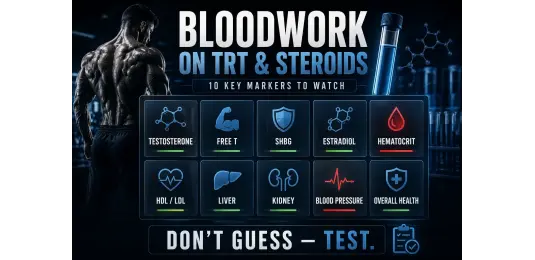
Bloodwork on TRT and steroids is not just a medical formality. It is the difference between guessing and actually understanding what is happening inside the body. Many athletes judge a cycle or TRT protocol by strength, libido, bodyweight, pumps, mood, and mirror changes. Those signs matter, but they do not show the full picture.
A man can feel strong while hematocrit is climbing. He can look fuller while blood pressure is moving in the wrong direction. He can have high testosterone but poor free testosterone availability because SHBG is changing the signal. He can blame estrogen for every symptom while the real issue involves prolactin, sleep, lipids, or cardiovascular strain.
This is why bloodwork matters on TRT and steroids. It turns vague symptoms into measurable patterns. It helps separate normal adaptation from early warning signs. It also helps prevent emotional decision-making, where a user changes dose, adds compounds, lowers estrogen, or blames one hormone without seeing the full panel.
The goal is not to scare anyone away from the topic. The goal is to explain what should be monitored, why each marker matters, and how experienced users think about bloodwork before making decisions.
Quick Summary
Bloodwork on TRT and steroids helps explain what symptoms alone cannot show.
Total testosterone and free testosterone are useful, but they do not tell the whole story without SHBG and estradiol.
Hematocrit, blood pressure, and cholesterol are key cardiovascular markers.
Liver and kidney markers help monitor stress from compounds, training, hydration, and overall health status.
Estradiol and prolactin can overlap with libido, mood, nipple sensitivity, and erectile symptoms.
Trends matter more than one isolated test. Consistent testing conditions make interpretation much stronger.
Good decisions come from patterns: bloodwork, symptoms, recovery, performance, and health markers together.
Why Bloodwork on TRT and Steroids Matters
Bloodwork on TRT and steroids matters because performance changes are not always the same thing as health changes.
A stronger bench press does not prove that blood pressure is stable. Better pumps do not prove that lipids are healthy. Higher libido does not prove that estradiol, prolactin, hematocrit, and SHBG are all in a reasonable place.
This is where many users make their first major mistake. They rely only on how they feel. Feeling good is important, but it can be misleading. Some health markers move quietly before symptoms appear.
Bloodwork gives structure to the process. It helps answer practical questions:
Is testosterone exposure producing the expected hormone response?
Is free testosterone matching total testosterone?
Is SHBG explaining symptoms that do not match the headline number?
Is estradiol too high, too low, or simply misunderstood?
Is hematocrit rising?
Are HDL, LDL, and triglycerides changing?
Are liver and kidney markers stable?
Is blood pressure matching the rest of the picture?
Good bloodwork on TRT and steroids is not about obsessing over every number. It is about building a repeatable monitoring system so decisions are based on evidence instead of panic.
Total testosterone is usually the first marker people look at, and for good reason. It shows the total amount of testosterone measured in blood, including bound and unbound forms.
On TRT, total testosterone helps show whether the protocol is producing the expected range of exposure. On steroid cycles, it can confirm that testosterone exposure is far above natural baseline.
But total testosterone is not enough by itself.
Two men can show similar total testosterone values and feel completely different. One may have stable libido, clear mood, and good recovery. Another may feel flat, inconsistent, or over-stimulated. The difference often comes from free testosterone, SHBG, estradiol, injection timing, sleep, and cardiovascular health.
This is why bloodwork on TRT and steroids should not stop at total testosterone. It is a starting point, not the final answer.
Marker 2: Free Testosterone
Free testosterone helps explain hormone availability. It reflects the smaller fraction of testosterone that is not tightly bound to proteins in the blood.
This marker often matters when symptoms do not match total testosterone. A man may show a strong total testosterone number but still have lower-than-expected free testosterone because SHBG is high. Another may have moderate total testosterone but high free testosterone because SHBG is low.
That difference can change how a protocol feels.
Free testosterone is especially useful when evaluating libido, recovery, mood, and androgen response. It does not explain everything, but it often gives better context than total testosterone alone.
For serious bloodwork on TRT and steroids, total testosterone and free testosterone should usually be interpreted together, not separately.
Marker 3: SHBG
SHBG stands for sex hormone-binding globulin. It binds testosterone and changes how much free testosterone remains available.
SHBG is one of the most overlooked markers in steroid and TRT bloodwork. Many users compare total testosterone numbers while ignoring the marker that helps explain why those numbers feel different from person to person.
High SHBG may make total testosterone look better than the user feels. Low SHBG may create sharper hormonal peaks, stronger free testosterone exposure, or more fluctuation depending on injection timing and protocol structure.
This is why SHBG belongs in any serious discussion of bloodwork on TRT and steroids.
Without SHBG, testosterone interpretation becomes less precise. With SHBG, free testosterone, total testosterone, and symptoms become much easier to connect.
Estradiol is one of the most misunderstood markers in hormone monitoring.
Many men treat estradiol as a problem hormone. That is a mistake. Men need estradiol for libido, erectile function, mood, joint comfort, recovery, bone health, and cardiovascular function.
The issue is balance.
High estradiol may contribute to water retention, nipple sensitivity, blood pressure changes, mood instability, and gynecomastia risk in some individuals. Low estradiol may contribute to dry joints, poor erections, low libido, flat mood, and poor recovery.
That overlap is exactly why bloodwork on TRT and steroids matters. Symptoms alone can be misleading.
Estradiol should be interpreted alongside testosterone, free testosterone, SHBG, blood pressure, libido, mood, and recent protocol changes. One number by itself is rarely enough.
Prolactin is another hormone that often gets confused with estradiol.
Libido changes, erectile issues, nipple sensitivity, and mood changes are often blamed on estrogen when prolactin may also be involved. This is especially relevant in discussions around certain anabolic compounds and sexual side effects.
Prolactin should not be guessed from symptoms alone. Bloodwork gives a clearer picture.
In practical terms, prolactin becomes useful when sexual function, nipple symptoms, mood, or recovery changes do not match testosterone and estradiol results.
This is another example of why bloodwork on TRT and steroids works best as a full-panel system. The goal is not to blame one hormone. The goal is to understand the pattern.
When discussing bloodwork on TRT and steroids, hematocrit is one of the most important health markers to monitor.
Hematocrit measures the percentage of blood volume occupied by red blood cells. Hemoglobin measures the oxygen-carrying protein inside those cells.
Testosterone can stimulate erythropoiesis, meaning red blood cell production may increase. This is one reason hematocrit often becomes a major topic among TRT patients and steroid users.
An increase in hematocrit does not automatically mean something dangerous is happening. Context matters. Hydration status, altitude, cardiovascular health, sleep quality, and testing conditions can all influence results.
However, persistent elevations deserve attention because hematocrit is one of the markers most commonly monitored during long-term testosterone use.
Bloodwork on TRT and steroids becomes much more valuable when hematocrit trends are reviewed over time rather than through isolated tests.
Cholesterol markers are among the most overlooked aspects of bloodwork on TRT and steroids.
Many users focus heavily on hormones while paying little attention to lipids. Unfortunately, cardiovascular markers can change significantly during performance-enhancing drug use.
The three markers most commonly reviewed are:
HDL (high-density lipoprotein)
LDL (low-density lipoprotein)
Triglycerides
Different compounds may affect lipid profiles differently, but the overall lesson remains the same: hormone optimization should not come at the expense of cardiovascular awareness.
A user may feel excellent while lipid markers move in an unfavorable direction. This is another example of why symptoms alone are not enough.
Bloodwork on TRT and steroids helps reveal changes that would otherwise remain invisible.
Blood pressure deserves a place among the most important markers because it connects directly to long-term cardiovascular health.
Many athletes spend considerable time monitoring hormones but rarely monitor blood pressure with the same consistency.
That is a mistake.
Water retention, bodyweight changes, stimulant use, cardiovascular adaptation, training stress, sleep quality, and hormone fluctuations can all influence blood pressure.
This marker is particularly important because blood pressure can move in the wrong direction long before obvious symptoms appear.
Bloodwork on TRT and steroids should always be considered alongside regular blood pressure monitoring.
The strongest monitoring strategy combines laboratory data with real-world cardiovascular measurements.
Liver markers are frequently discussed whenever oral anabolic compounds enter the conversation.
The most common markers include:
AST
ALT
GGT
Interpreting these markers requires context.
Heavy training itself can influence some liver-related laboratory values. This is one reason bloodwork on TRT and steroids should never be interpreted without understanding training status, recovery, hydration, and recent physical activity.
Liver markers become more useful when viewed as part of a larger pattern rather than as isolated numbers.
Monitoring trends allows athletes to make better-informed decisions and avoid reacting emotionally to a single laboratory result.
The 10 Most Important Bloodwork Markers at a Glance
Marker
Why It Matters
Total Testosterone
Overall hormone exposure
Free Testosterone
Hormone availability
SHBG
Controls hormone binding
Estradiol
Hormone balance and symptoms
Prolactin
Sexual function and symptom overlap
Hematocrit
Red blood cell monitoring
HDL / LDL / TG
Cardiovascular health
Blood Pressure
Cardiovascular monitoring
AST / ALT / GGT
Liver health context
Creatinine / eGFR / BUN
Kidney monitoring
Why Trends Matter More Than One Test
One of the most valuable lessons experienced TRT patients and steroid users eventually learn is that trends are usually more useful than individual results.
A single laboratory value provides a snapshot. Multiple blood tests collected under consistent conditions provide a story.
This is why bloodwork on TRT and steroids should ideally be performed using similar testing conditions whenever possible.
Comparing bloodwork taken under wildly different circumstances often creates confusion instead of clarity.
Trend analysis allows athletes to identify meaningful changes while reducing the risk of overreacting to normal variation.
Common Bloodwork Mistakes
Testing Too Randomly
One of the most common mistakes with bloodwork on TRT and steroids is testing under inconsistent conditions. One test may be done after poor sleep, another after heavy training, another after dehydration, and another at a completely different point in the injection schedule.
That kind of testing can create confusion. The numbers may change, but the change may reflect timing and conditions rather than a real shift in health status.
Looking at Hormones but Ignoring Health Markers
Many users focus heavily on testosterone, free testosterone, estradiol, and SHBG while ignoring hematocrit, cholesterol, blood pressure, liver markers, and kidney markers.
This is a serious mistake. Bloodwork on TRT and steroids should explain both hormone response and health risk.
Reacting Emotionally to One Number
One abnormal or unexpected value should not automatically trigger a major protocol change. Context matters. Trends matter. Symptoms matter.
The strongest decisions come from patterns, not panic.
Ignoring Blood Pressure
Blood pressure is not technically part of a standard blood test, but it belongs in the same monitoring system. A user can have impressive hormone numbers and still have blood pressure moving in the wrong direction.
When Bloodwork Should Be Checked
There is no single schedule that fits every person, but bloodwork on TRT and steroids should be performed often enough to understand trends.
Testing is especially useful:
Before starting TRT or a cycle
After a protocol has stabilized
When symptoms appear
After major changes in dose, frequency, or compounds
During long-term monitoring
Before making aggressive estrogen or prolactin decisions
Baseline bloodwork is especially valuable because it gives future tests something to compare against. Without baseline data, it becomes harder to know whether a marker is truly abnormal for that individual.
Bloodwork on TRT and steroids works best when it is planned, repeated, and interpreted calmly.
Why Symptoms and Bloodwork Must Work Together
Symptoms matter. Bloodwork matters. Neither should replace the other.
A user may feel good while hidden markers are moving in the wrong direction. Another user may feel bad while the obvious hormone numbers look strong. The answer usually comes from comparing symptoms with the full panel.
This is why bloodwork on TRT and steroids should be viewed as a decision-making tool, not just a document to collect.
The goal is to connect:
How the user feels
How the user performs
How recovery looks
How blood pressure behaves
How hormone markers move
How cardiovascular and organ markers trend
Once those pieces are viewed together, decisions become more logical and less emotional.
Practical Takeaway
Bloodwork on TRT and steroids matters because symptoms alone never show the full picture.
Total testosterone, free testosterone, SHBG, estradiol, prolactin, hematocrit, cholesterol, blood pressure, liver markers, and kidney markers all help explain different parts of the same system.
The smartest users do not chase one perfect number. They build a monitoring framework. They compare trends. They track symptoms. They pay attention to health markers before problems become obvious.
Performance matters, but long-term performance depends on health staying organized.
Good bloodwork does not remove all risk. It simply makes decision-making more informed, calmer, and more precise.
Q: What bloodwork should I check on TRT or steroids?
Useful markers often include total testosterone, free testosterone, SHBG, estradiol, prolactin, CBC, hematocrit, lipids, liver markers, kidney markers, and blood pressure.
Q: Why is hematocrit important on testosterone?
Testosterone can increase red blood cell production in some users. Hematocrit helps monitor red blood cell concentration over time.
Q: Can steroid bloodwork look good if I feel bad?
Yes. A limited panel may look acceptable while other markers such as estradiol, SHBG, prolactin, blood pressure, lipids, or recovery patterns explain symptoms.
Q: How often should bloodwork be checked on TRT?
Testing frequency depends on the individual and the protocol, but baseline testing, follow-up testing after stabilization, and ongoing monitoring are commonly used.
Q: What blood markers show steroid side effects?
No single marker shows everything. Hematocrit, lipids, blood pressure, liver markers, kidney markers, estradiol, prolactin, and hormone markers all provide different clues.
Q: Why do cholesterol markers matter on steroids?
HDL, LDL, and triglycerides help show cardiovascular risk patterns that may change during TRT or anabolic steroid use.