Bodybuilding Articles: TRT, Side Effects and Guides

Guides: Steroids, TRT, Side Effects and Cycles

This section brings together practical articles on testosterone, TRT, side effects, cycle structure, and support strategy. It is designed for readers who want to understand how performance compounds are usually approached in the real world, how common problems develop, and how structure matters more than random compound choice.

If you are starting with the basics, begin with TRT Explained, review natural testosterone vs TRT, and compare testosterone undecanoate vs enanthate. For support products tied to hormone control and recovery, use Cycle & PCT Support.


How to Use This Section

The articles below are meant to help you move from general understanding into more specific decision-making. Some explain testosterone foundations and TRT logic, others focus on estrogen control, gynecomastia, water retention, blood pressure, hematocrit, kidney stress, and practical comparison topics. This makes the page useful both for beginners who need a clean starting point and for experienced users trying to solve a specific issue during a cycle, cruise, or TRT phase.

Instead of treating everything as separate topics, the goal here is to connect hormones, side effects, compound choice, and health support into one readable system. That is also why this section works well alongside Product Type, Testosterone Base, Testosterone Blends, MedRX, and Heart & Vascular. Users can read the educational side here and then move into the relevant product or support category without losing context.


Why These Articles Matter

A lot of problems in performance use happen because people jump straight into compounds without understanding delivery, suppression, estrogen balance, recovery, or long-term marker management. A clean article hub helps reduce that confusion. Readers can compare TRT and natural optimization, understand why testosterone base matters, learn how mixed esters differ from single esters, and see why support strategy is often more important than chasing a more advanced stack.

This page also supports stronger internal navigation across the site. Someone reading about testosterone can move naturally into comparison articles, then into cycle support, then into broader health-support categories when the topic shifts toward blood pressure, lipids, organ stress, sleep, or recovery. That creates a better user path, improves crawl logic, and gives the page enough meaningful text to avoid looking thin or mechanically assembled.


Frequently Asked Questions

Where should beginners start with these articles?

Beginners should usually start with testosterone basics and TRT fundamentals before moving into advanced comparison or side effect topics. That gives enough context to understand suppression, ester choice, recovery logic, and why support strategy matters. Once that foundation is clear, comparison articles and risk-control guides become much easier to use in a practical way.

Is TRT the same thing as a steroid cycle?

No. TRT is intended to restore and maintain normal physiological testosterone levels, while anabolic steroid cycles are usually built around supraphysiological exposure for performance or physique goals. The overlap is that both involve hormones, bloodwork, and side effect management, but the purpose, dosing logic, and expected outcomes are very different.

Why are side effect articles important on an article hub like this?

Side effect articles add practical value because most users are not only comparing compounds, they are also trying to understand real problems like water retention, gynecomastia, elevated blood pressure, thicker blood, or kidney-related stress markers. Putting these topics in the same section makes the page more useful and gives readers a more complete view of how performance use actually works.

Why link articles to Cycle & PCT Support and MedRX?

Articles explain the logic, while support categories help users find the related compounds and health-support products tied to that topic. Cycle & PCT Support fits estrogen control, recovery, and on-cycle management, while MedRX is broader and better for blood pressure, cholesterol, recovery, sleep, and other health-related support concerns that can appear during longer protocols.

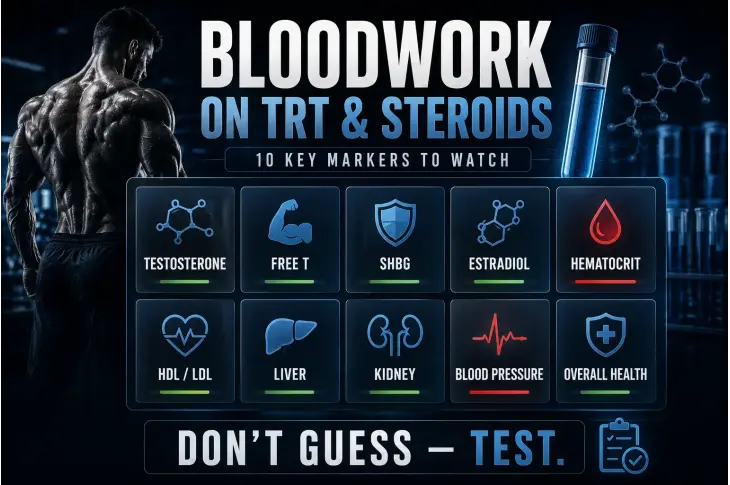
Why Bloodwork Matters on TRT and Steroids: The 10 Most Important Markers

Why Bloodwork Matters on TRT and Steroids: The 10 Most Important Markers

By Ethan Cole On June 3, 2026
Bloodwork matters on TRT and steroids because symptoms alone never tell the full story. Learn the 10 key markers that help explain hormones, health risks, and performance outcomes.
Aromatase Inhibitors on TRT and Steroids: When They Help and When They Cause Problems

Aromatase Inhibitors on TRT and Steroids: When They Help and When They Cause Problems

By Ethan Cole On June 2, 2026
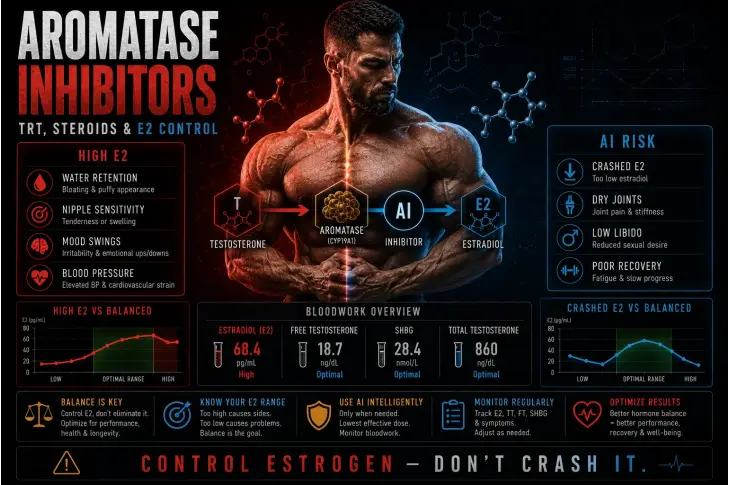
Aromatase inhibitors are commonly used to manage estradiol during TRT and steroid cycles. Learn how Arimidex, Aromasin, and related compounds affect estrogen, recovery, libido, and bloodwork.
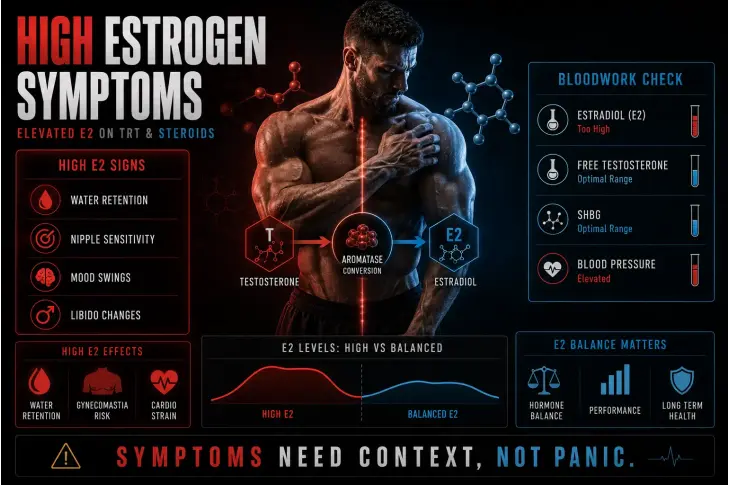
High Estrogen Symptoms on Steroids and TRT: What Elevated E2 Really Feels Like

High Estrogen Symptoms on Steroids and TRT: What Elevated E2 Really Feels Like

By Ethan Cole On June 1, 2026
High estrogen symptoms on steroids and TRT are often misunderstood. Learn how elevated estradiol affects water retention, libido, erections, mood, blood pressure, and hormone balance.
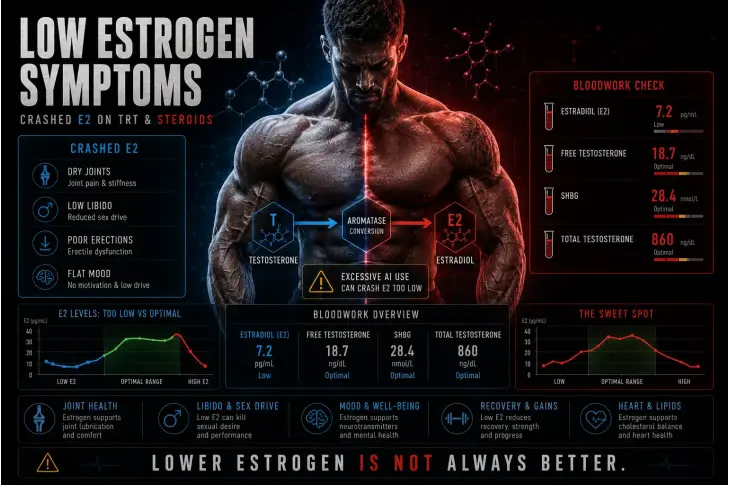
Low Estrogen Symptoms on Steroids and TRT: Why Crashed E2 Can Feel Worse Than High Estrogen

Low Estrogen Symptoms on Steroids and TRT: Why Crashed E2 Can Feel Worse Than High Estrogen

By Ethan Cole On May 31, 2026
Low estrogen is one of the most common yet misunderstood hormone problems on TRT and steroids. Learn how crashed E2 affects libido, joints, mood, erections, recovery, and performance.
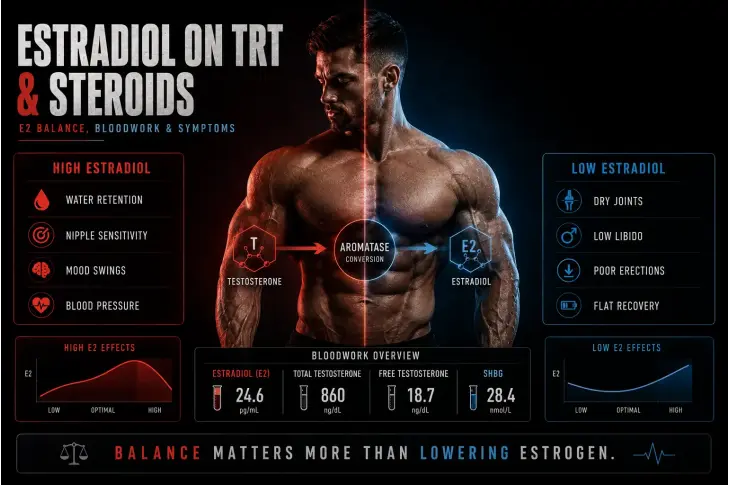
Estradiol on TRT and Steroids: Why E2 Matters More Than Most Men Think

Estradiol on TRT and Steroids: Why E2 Matters More Than Most Men Think

By Ethan Cole On May 30, 2026
Estradiol is one of the most misunderstood hormones in men. Learn how E2 influences libido, erections, recovery, mood, blood pressure, and testosterone therapy outcomes.
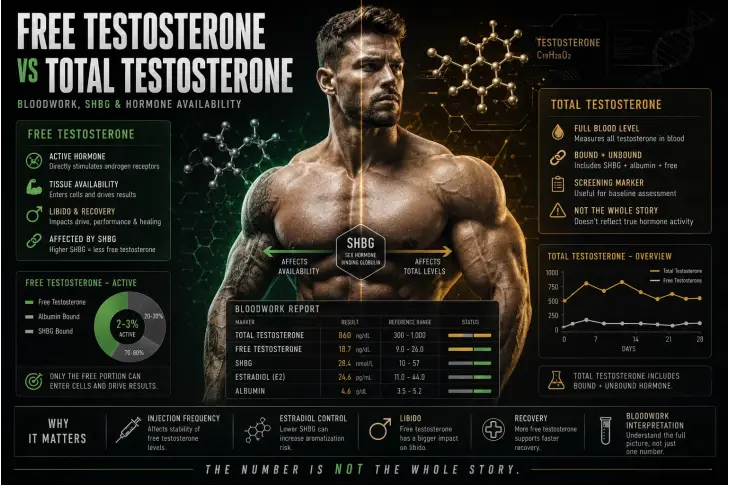
Free Testosterone vs Total Testosterone: What Actually Matters on TRT and Steroids

Free Testosterone vs Total Testosterone: What Actually Matters on TRT and Steroids

By Ethan Cole On May 29, 2026
Free testosterone vs total testosterone is one of the most misunderstood topics in hormone bloodwork. Learn what each marker means, how SHBG changes interpretation, and why symptoms often matter more than a single lab result.
SHBG on Steroids and TRT: Why Free Testosterone Tells the Real Story

SHBG on Steroids and TRT: Why Free Testosterone Tells the Real Story

By Ethan Cole On May 27, 2026
SHBG on steroids and TRT can change how total testosterone, free testosterone, libido, mood, estrogen symptoms, and bloodwork should be interpreted.
Steroid Detection Times

Steroid Detection Times

By Dr. Miranda Bails On April 21, 2026
Detection time and half-life are not the same number — and confusing them is one of the most expensive mistakes a tested athlete can make. This article covers how anti-doping testing actually works, why detection windows extend far beyond compound clearance, and the realistic detection times for every major anabolic steroid class.
Androgenic Side Effects of Steroids

Androgenic Side Effects of Steroids

By Dr. Miranda Bails On April 20, 2026
Androgenic side effects — acne, body hair growth, scalp hair loss, prostate stress, and virilisation — are not random. They are predictable consequences of DHT receptor activation, and their severity scales directly with compound androgenic ratio, dose, and individual genetic sensitivity to DHT. Understanding the mechanism allows for compound selection that minimises androgenic exposure without sacrificing anabolic output.
Libido and Erectile Dysfunction on Steroids

Libido and Erectile Dysfunction on Steroids

By Dr. Miranda Bails On April 19, 2026
Low libido and erectile dysfunction on steroids are not random side effects — they are predictable consequences of specific hormonal imbalances. Prolactin elevation, estrogen that is too high or too low, and post-cycle testosterone crash each produce recognisably different presentations. Identifying which mechanism is active determines the correct intervention.
Post-Injection Pain (PIP) on Steroids

Post-Injection Pain (PIP) on Steroids

By Dr. Miranda Bails On April 18, 2026
Post-injection pain is one of the most common practical complaints among athletes who inject — and one of the most preventable. The severity varies from barely noticeable to incapacitating, and it depends on factors that are almost entirely within the athlete's control: compound selection, formulation, and injection technique.
Joint Pain on Steroids

Joint Pain on Steroids

By Dr. Miranda Bails On April 17, 2026
Joint pain on a steroid cycle has two completely different causes that require opposite management approaches. Identifying which mechanism is driving the pain — dry-joint DHT compounds or estrogen deficiency from AI over-suppression — determines the correct intervention. Getting this wrong makes the problem worse.