Free Testosterone vs Total Testosterone: What Actually Matters on TRT and Steroids
  • By Ethan Cole
  • May 29, 2026
  • Reading Time: 18 mins
Free Testosterone vs Total Testosterone: What Actually Matters on TRT and Steroids
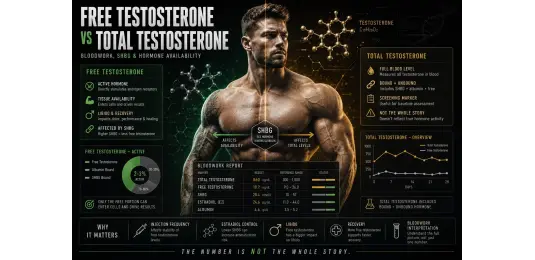
Hormone Bloodwork Guide

Free Testosterone vs Total Testosterone: What Actually Matters on TRT and Steroids

Free testosterone vs total testosterone is one of the first bloodwork topics that confuses men on TRT, steroid cycles, or hormone optimization. A total testosterone number can look strong, even impressive, while libido, recovery, mood, and training drive still feel off. That is usually the moment when free testosterone, SHBG, estradiol, and the full hormone picture start to matter.

Quick Summary

  • Total testosterone measures all testosterone in the bloodstream, including bound and unbound forms.
  • Free testosterone reflects the smaller fraction that is not tightly bound and is more available to tissues.
  • Free testosterone vs total testosterone matters most when symptoms and lab numbers do not match.
  • SHBG can make total testosterone look better or worse than the real androgen effect feels.
  • Good interpretation also includes estradiol, albumin, hematocrit, lipids, blood pressure, sleep, recovery, and symptoms.

Why Free Testosterone vs Total Testosterone Matters

Free testosterone vs total testosterone matters because testosterone does not circulate in one simple form. Some testosterone is tightly bound to SHBG, some is loosely bound to albumin, and a small portion remains free. Total testosterone counts all of it together, but the body does not "feel" all of those fractions the same way.

This is why a man can see a high total testosterone result and still feel underpowered. Libido may be inconsistent, erections may not match expectations, recovery may feel average, and training aggression may not be there. The number looks good, but the body is giving a different report.

In practical bodybuilding and TRT settings, free testosterone vs total testosterone helps explain that gap. Total testosterone gives a broad overview. Free testosterone gives a clearer look at hormone availability. Neither marker should be read alone.

Experienced users usually learn this the hard way. They stop asking only, "What is my testosterone level?" and start asking, "How much is free, what is SHBG doing, where is estradiol, and do the symptoms match the labs?"

What Total Testosterone Actually Measures

Total testosterone measures all testosterone circulating in blood. That includes testosterone bound tightly to SHBG, testosterone loosely bound to albumin, and free testosterone.

This makes total testosterone useful, but incomplete. It is a headline number, not the whole story. For diagnosis, TRT monitoring, and steroid bloodwork, total testosterone still matters because it shows the overall androgen load. The mistake is treating it as the only number that matters.

Think of total testosterone like total money in an account. It tells you what exists. It does not tell you what is available to use right now. That is where free testosterone and bioavailable testosterone become more useful.

On TRT, total testosterone may look stable while symptoms still move. On cycle, total testosterone may look extremely high while cardiovascular strain, estradiol movement, or SHBG changes explain why the user feels worse than expected.

What Free Testosterone Actually Measures

Free testosterone is the portion of testosterone not tightly bound to blood proteins. It is a smaller fraction, but it often tells a more useful story about androgen availability.

That does not mean free testosterone is perfect. Testing methods vary, calculated values depend on other markers, and symptoms still matter. But when total testosterone and real-world response do not match, free testosterone often gives the next clue.

Free testosterone vs total testosterone becomes especially important for men who feel low despite "normal" or even high total testosterone. High SHBG can bind more testosterone and reduce the free fraction. Low SHBG can increase free testosterone but may also create a sharper, less stable hormone feel.

This is why modern hormone interpretation is not about chasing one perfect lab value. It is about reading the pattern.

Free Testosterone vs Total Testosterone: Side-by-Side Comparison

One reason free testosterone vs total testosterone creates confusion is that both markers describe testosterone, but they answer different questions.

Total testosterone tells you how much testosterone exists in circulation. Free testosterone helps explain how much testosterone is available to tissues. Neither marker is superior in every situation. The strongest interpretation comes from using both together.

Free Testosterone Total Testosterone
Reflects available testosterone Measures all testosterone in circulation
Often correlates better with symptoms Provides broader hormonal context
Strongly influenced by SHBG Less affected by SHBG fluctuations
Helpful for libido and symptom interpretation Helpful for diagnosis and monitoring
May explain why a user feels low despite normal labs Shows overall androgen exposure

When free testosterone vs total testosterone appears contradictory, SHBG is often the missing piece that explains the difference.

Related reading: This article connects directly with SHBG on Steroids and TRT, TRT Explained, Libido and ED on Steroids, and Estrogen Control on Cycle.

Free Testosterone vs Total Testosterone and Aging

Aging is one of the reasons free testosterone vs total testosterone becomes more important over time. Many men notice symptoms that resemble low testosterone despite bloodwork that appears acceptable on the surface.

One explanation is that SHBG often increases with age. As SHBG rises, a larger percentage of testosterone can become bound. Total testosterone may remain inside the laboratory reference range while free testosterone gradually declines.

This is one reason experienced TRT physicians rarely look at total testosterone alone. Men in their forties, fifties, and sixties may have similar total testosterone values but very different free testosterone levels.

Free testosterone vs total testosterone becomes especially important when symptoms include reduced libido, lower recovery capacity, declining training performance, increased fatigue, or reduced motivation despite apparently normal bloodwork.

That does not mean every symptom is caused by testosterone. Sleep quality, cardiovascular health, medications, thyroid status, body composition, and overall health still matter. The key point is that aging often makes free testosterone interpretation more valuable than it was earlier in life.

The Role of SHBG in Free Testosterone vs Total Testosterone

Why SHBG Changes the Meaning of the Number

SHBG stands for sex hormone-binding globulin. It binds testosterone tightly and changes how much free testosterone remains available. Once SHBG is added to the picture, free testosterone vs total testosterone becomes much easier to understand.

High SHBG can make total testosterone look strong while free testosterone remains lower than expected. A user may feel flat, low-libido, or underdosed even though the total testosterone number looks fine.

Low SHBG can create the opposite pattern. Total testosterone may not look extreme, but free testosterone may be high. Some users feel stronger this way. Others feel unstable, more estrogen-sensitive, or more affected by injection peaks and troughs.

This is why SHBG should be part of serious testosterone bloodwork. Without SHBG, total testosterone and free testosterone are harder to interpret accurately.

Low SHBG and Hormonal Volatility

Low SHBG is not automatically "better." A low SHBG user may feel testosterone quickly after an injection, then feel the drop sooner. Libido, mood, water retention, and energy can swing harder.

This is common in real TRT discussions. One man feels great for two days after a shot, then crashes. Another man using the same weekly dose feels stable. The difference may involve SHBG, injection frequency, estradiol, sleep, body fat, and insulin sensitivity.

High SHBG and Low Free Testosterone Symptoms

High SHBG can make the lab report look better than the user feels. Total testosterone may be high-normal or elevated, but free testosterone stays unimpressive.

In that situation, increasing testosterone blindly is not always the clean answer. The smarter move is to understand free testosterone, SHBG, albumin, estradiol, thyroid context, liver markers, and symptoms before changing the protocol.

Why Two Men With the Same Testosterone Level Can Feel Completely Different

This is where free testosterone vs total testosterone becomes more useful than simple number chasing. Two men can both show a total testosterone level around the same range and have completely different experiences.

One man may feel stable, strong, sexually responsive, and mentally clear. Another may feel tired, irritable, low-libido, bloated, or emotionally flat. Online, people often assume one of them is exaggerating. In practice, their physiology may simply be different.

The difference can come from SHBG, estradiol, albumin, thyroid status, body fat, insulin sensitivity, sleep quality, stress load, blood pressure, and cardiovascular condition. A lean, insulin-sensitive athlete with stable sleep and good lipids may tolerate a hormone level very differently than someone with poor sleep, high stress, elevated body fat, and unstable blood pressure.

Injection timing also matters. A man with lower SHBG may feel a large injection more aggressively because the hormone peak hits harder and fades faster. Another man with higher SHBG may feel smoother but may not get as much free testosterone from the same total number.

This is why free testosterone vs total testosterone should be interpreted as part of the full body picture. The lab result is real, but it is not the full story by itself. The useful question is not only "What is the number?" The better question is "Does this number match the person, the symptoms, and the rest of the bloodwork?"

Free Testosterone vs Total Testosterone on TRT

Free testosterone vs total testosterone is a major topic in TRT because men often compare doses without comparing bloodwork context.

Two men can use similar TRT doses and get completely different outcomes. One has stable libido, strong recovery, and clear mood. The other feels flat, irritable, or inconsistent. The difference may not be the testosterone product alone. It may be SHBG, estradiol, injection timing, body composition, sleep, or cardiovascular health.

On TRT, total testosterone is still useful because it shows the broader level. Free testosterone helps explain whether that level is translating into available androgen activity. SHBG explains why the two may not match.

That is why free testosterone vs total testosterone should be read together, not as competing markers. The goal is not to pick one and ignore the other. The goal is to understand how the full panel behaves.

Free Testosterone vs Total Testosterone on Steroid Cycles

On steroid cycles, free testosterone vs total testosterone becomes more complicated because hormone exposure moves outside normal physiology. Exogenous testosterone can push total testosterone very high, but that does not automatically mean the cycle feels clean or productive.

A user can have very high total testosterone and still feel bad if estradiol is poorly managed, blood pressure rises, sleep gets worse, hematocrit climbs, or free testosterone moves in a way the body does not tolerate well.

With steroids, the highest testosterone number is not the same as the best outcome. More androgen exposure can increase strength, fullness, and performance, but it can also increase side effects and health strain.

That is why steroid bloodwork needs more than total testosterone. Free testosterone, SHBG, estradiol, CBC, lipids, liver markers, kidney context, and blood pressure all belong in the same conversation.

Useful testosterone context: For ester timing and bloodwork patterns, read Testosterone Enanthate vs Cypionate, Testosterone Propionate vs Enanthate, Testosterone Base: Why It Matters, and Testosterone Blends.

Free Testosterone vs Total Testosterone and Libido

Libido is one of the main reasons men start caring about free testosterone vs total testosterone. A total testosterone number can look solid while sexual interest, erection quality, and confidence still feel unreliable.

That does not always mean testosterone is too low. Libido sits inside a wider system. Free testosterone matters, but estradiol, prolactin, sleep, cardiovascular health, stress, dopamine tone, relationship context, and erectile function all play a role.

A man with high total testosterone and high SHBG may still have lower free testosterone than expected. Another man with high free testosterone but poorly controlled estradiol may also have libido problems. A third man may have acceptable hormones but high blood pressure, poor sleep, and nervous system fatigue that damage sexual performance.

This is why free testosterone vs total testosterone is useful but not complete by itself. It helps explain hormone availability, but libido still needs full context. For deeper symptom interpretation, the guide on Libido and ED on Steroids connects closely with this topic.

Free Testosterone vs Total Testosterone and Training Performance

Many lifters assume higher total testosterone should automatically mean better training. Sometimes it does. But free testosterone vs total testosterone explains why the relationship is not always linear.

Training response depends on available androgen signaling, recovery, sleep, nutrition, nervous system stress, estradiol balance, red blood cell markers, blood pressure, and joint health. A user can have a strong total testosterone result and still train poorly if sleep is broken, estradiol is crashed, blood pressure is high, or recovery capacity is overwhelmed.

Free testosterone may better reflect how much androgen signal is available, but even that is only one part of performance. The bodybuilder who grows consistently is usually not the one chasing the highest number. It is the one who can train hard, recover, keep appetite stable, manage blood pressure, and avoid health markers drifting too far in the wrong direction.

That is why serious athletes read testosterone bloodwork with performance notes. Strength progression, pump quality, recovery between sessions, mood, soreness, sleep, and libido all help explain whether the bloodwork is translating into useful results.

Bioavailable Testosterone Explained

Bioavailable testosterone sits between free testosterone and total testosterone as a concept. It usually includes free testosterone plus testosterone loosely bound to albumin.

This matters because albumin-bound testosterone is not held as tightly as SHBG-bound testosterone. It may become available more easily. For that reason, bioavailable testosterone can sometimes give useful context when SHBG is high or low.

In real bloodwork interpretation, bioavailable testosterone is not always ordered, but the concept helps users understand why total testosterone can be misleading. Some testosterone is present but tightly bound. Some is more available. Some is free.

That is the heart of the free testosterone vs total testosterone discussion. Availability matters, not only quantity.

Estradiol Changes the Interpretation

Why Testosterone Numbers Do Not Explain Every Symptom

Free testosterone vs total testosterone should never be interpreted without estradiol. A user may blame testosterone for libido or mood problems when estradiol is the marker creating the symptoms.

Low estradiol can cause dry joints, low libido, poor erections, flat mood, and weak training feel. High estradiol can contribute to water retention, nipple sensitivity, emotional volatility, and blood pressure changes.

This is why aggressive AI use can backfire. If a user sees high total testosterone and feels bad, crushing estradiol without understanding free testosterone, SHBG, and symptoms can make the situation worse.

Better interpretation means looking at the full pattern before making changes.

When Testosterone Bloodwork Should Be Repeated

Free testosterone vs total testosterone should not be judged from one messy blood test. Timing matters. Testing conditions matter. A lab drawn after poor sleep, unusual training stress, dehydration, illness, or a changed injection schedule may not represent the usual pattern.

For better interpretation, bloodwork should be repeated under consistent conditions when possible. Use the same lab if you can. Test at a similar time of day. Keep injection timing consistent. Avoid comparing a trough result to a peak result as if they mean the same thing.

This is especially important on TRT. One man may test near peak concentration and look high. Another may test near trough and look lower. Without timing context, free testosterone vs total testosterone can be misread.

Cycles are even more complicated because multiple compounds, changing doses, oral steroids, aromatase inhibitors, and lifestyle stress can all move bloodwork. The cleaner the testing conditions, the easier it is to understand what is actually happening.

Why Testosterone Results Can Differ Between Laboratories

Free testosterone vs total testosterone can become confusing when two laboratory reports show different results despite similar testing conditions.

One reason is methodology. Some laboratories directly measure free testosterone, while others estimate or calculate it using total testosterone, SHBG, and albumin. Different calculation models can produce slightly different results.

Reference ranges can also vary between laboratories. A result considered normal in one lab may appear borderline in another. This is why experienced clinicians often prefer using the same laboratory whenever possible when monitoring TRT or steroid bloodwork.

Consistency matters more than chasing one isolated number. If bloodwork is repeated under similar conditions using the same laboratory, trends become much easier to interpret.

For long-term monitoring, the trend often provides more useful information than any single free testosterone vs total testosterone result.

Bloodwork Markers That Matter Alongside Testosterone

Free testosterone vs total testosterone is only one part of useful hormone monitoring. A serious panel should include enough markers to explain both performance and health risk.

  • Total Testosterone
  • Free Testosterone
  • SHBG
  • Albumin
  • Estradiol
  • CBC and Hematocrit
  • Lipid Panel
  • Liver Enzymes
  • Kidney Markers
  • Blood Pressure

Testosterone can look perfect while health markers move in the wrong direction. That is especially important for users who stay on TRT long-term or run repeated cycles.

The same monitoring framework connects with Hematocrit on Steroids, High Blood Pressure on Steroids, Cholesterol on Steroids, and Kidney Stress on Steroids.

Marker Why It Matters
Total Testosterone Shows the full amount of testosterone measured in blood.
Free Testosterone Helps explain available androgen activity and symptoms.
SHBG Explains why total and free testosterone may not match.
Estradiol Strongly affects libido, mood, water retention, joints, and sexual function.
Hematocrit Shows red blood cell concentration and blood thickness context.
Lipids Tracks HDL, LDL, triglycerides, and cardiovascular strain.

Products Commonly Discussed in Testosterone Bloodwork

Free testosterone vs total testosterone naturally comes up when users compare testosterone products, esters, and injection schedules. Different esters can create different timing patterns, and those patterns may change how bloodwork feels.

Common testosterone products discussed in this context include:

These product links are not a substitute for bloodwork interpretation. They are relevant because testosterone type, ester length, injection frequency, and individual response all shape the free testosterone vs total testosterone picture.

Common Mistakes With Free Testosterone vs Total Testosterone

Using Total Testosterone Alone

This is the most common mistake. Total testosterone is useful, but it cannot explain hormone availability by itself.

Ignoring SHBG

Without SHBG, free testosterone vs total testosterone is harder to interpret. SHBG often explains why two users with similar total testosterone feel completely different.

Changing Too Many Variables at Once

Changing dose, injection frequency, AI use, and compounds all at once makes bloodwork harder to read. Serious users make changes slowly and retest under consistent conditions.

Forgetting Health Markers

Testosterone numbers can look good while blood pressure, hematocrit, or lipids move in the wrong direction. Good hormone management protects performance and health at the same time.

Chasing One Perfect Number

Free testosterone vs total testosterone is not about finding one magic value. The body is not a spreadsheet. A number can be technically high and still not produce a good outcome if the rest of the system is stressed.

Most experienced users eventually learn to look for a stable pattern instead of a trophy lab result. Strong training, steady libido, good sleep, manageable blood pressure, clean lipids, reasonable estradiol, and consistent mood matter more than winning a screenshot contest online.

Practical Takeaway

Free testosterone vs total testosterone is not a debate where one marker wins and the other loses. Both matter.

Total testosterone shows the broad hormone level. Free testosterone helps explain availability. SHBG helps explain why those two numbers may not match. Estradiol, albumin, blood pressure, lipids, hematocrit, and symptoms complete the picture.

The best interpretation is calm and practical. Do not chase one perfect number. Read the pattern, compare symptoms, track health markers, and avoid making emotional protocol changes from one isolated result.

Frequently Asked Questions

Q: Which is more important, free testosterone or total testosterone?

Both matter. Total testosterone shows the full measured amount in blood, while free testosterone helps explain hormone availability and symptoms.

Q: Can free testosterone be low when total testosterone is normal?

Yes. High SHBG can bind more testosterone and reduce free testosterone even when total testosterone looks normal or strong.

Q: Why do I feel bad if my testosterone level is high?

High total testosterone does not guarantee good symptoms. Free testosterone, SHBG, estradiol, sleep, blood pressure, lipids, and recovery all affect how testosterone feels.

Q: What affects free testosterone levels?

SHBG, albumin, age, body composition, insulin sensitivity, thyroid status, liver function, medications, and testosterone dose can all affect free testosterone.

Q: Why is my free testosterone low but total testosterone normal?

High SHBG is one of the most common reasons. A man may have normal total testosterone but lower free testosterone because more hormone is bound and less remains available to tissues. This is why SHBG should be interpreted alongside total testosterone, free testosterone, albumin, and symptoms.

Q: Should SHBG be tested with testosterone?

Yes, SHBG gives important context. Testing total testosterone, free testosterone, SHBG, albumin, and estradiol together gives a clearer hormone picture.