Testosterone Blends: When Mixed Esters Make Sense
  • By Dr. Zimer H.
  • April 8, 2026
  • Reading Time: 5 mins
Testosterone Blends: When Mixed Esters Make Sense
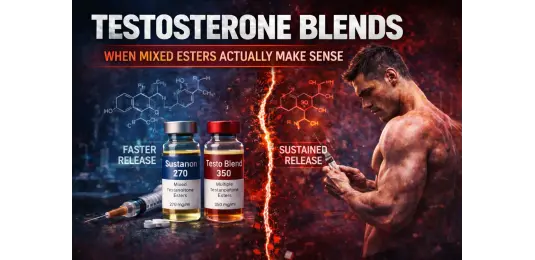
Testosterone Blends: When Mixed Esters Actually Make Sense

Introduction

After understanding the role of a testosterone base, many users start looking at blends expecting better or faster results. In practice, blends are not about increasing output — they are about changing how testosterone behaves inside the cycle. The compound remains the same, but the release pattern becomes more complex.

This distinction matters. Cycles are not built on compounds alone, but on stability. If the release pattern does not match injection frequency, recovery rhythm, and overall structure, even a well-chosen product can feel inconsistent. Testosterone blends only work when they fit the system around them.

What a Testosterone Blend Actually Means

A testosterone blend combines multiple esters into one injectable compound. Each ester releases at a different rate, creating a layered hormonal curve instead of a single predictable line. Part of the dose becomes active quickly, while another part sustains levels over time.

This is the defining idea behind the Testosterone Blends category. However, the body does not respond to esters individually — it responds to total hormone exposure. This means the complexity of a blend does not guarantee smoother results unless the overall structure is controlled.

Why Blends Are Used in Some Cycles

Release Pattern

Blends exist to combine fast and slow activity in one compound. This can create a more continuous hormonal presence without switching between different testosterone types. For some users, this results in a cycle that feels more balanced across the week.

Cycle Simplicity

Instead of managing multiple testosterone products, a blend consolidates everything into one injection schedule. In stacks that already include compounds from injectable steroids, this can reduce unnecessary variables and simplify planning.

User Preference

Some athletes prefer blends because of how they feel in training. This is not about strength differences, but about consistency, rhythm, and how stable performance feels over time.

Choosing Between Blend and Single Ester

The real difference is control. Single esters provide a clear and predictable release, making them easier to adjust when needed. This is why they are often used when dialing in dosage, managing estrogen, or correcting instability.

Blends introduce overlap between esters, which can make adjustments less precise. While they may feel smoother in some cases, they can also make it harder to identify what is causing changes in performance or side effects. This is why comparisons such as Sustanon vs Test Enanthate remain important when choosing between approaches.

Common options include:

  • Sustanon 270 — mixed esters with both short and long release phases
  • Testo Blend 350 — higher concentration blend used in structured cycles
  • Enanthate 250 — single ester baseline with predictable stability

Estrogen and Stability

Testosterone blends still aromatize into estrogen. The presence of multiple esters does not change this process, but it can change how stable estrogen levels feel throughout the week. Fluctuations in release may translate into fluctuations in water balance, mood, and training response.

This is why estrogen control remains a key factor in any testosterone-based cycle. Users often refer to Estrogen Control on Cycle to understand how to maintain balance without overcorrecting and creating additional instability.

Health Support Considerations

With testosterone blends, support is closely tied to consistency. Because esters release at different speeds, even small deviations in injection timing can create noticeable shifts in how the cycle feels. These shifts are not always extreme, but over time they can affect recovery, energy levels, and overall training stability.

Unlike single esters, where adjustments are more direct, blends require a tighter routine to stay predictable. Support strategies are therefore used not only to correct issues, but to maintain stability before problems become visible.

  • Aromasin — helps maintain steady estrogen control when levels fluctuate
  • Nebicard 5 mg — supports blood pressure stability during less predictable hormonal patterns
  • Atorlip 10 mg — helps manage lipid balance during extended or higher-load cycles

In practice, blends reward precision. The more consistent the schedule and support, the more stable the overall cycle becomes.

Real-World Take

In real use, testosterone blends are not inherently better or worse than single esters. They are simply different. The outcome depends on how well the user matches the compound to their routine and overall cycle design.

Users who prioritize simplicity and clear adjustments often stay with single esters. Those who understand their response and want a more layered release pattern may choose blends. In both cases, structure determines results.

Conclusion

Testosterone blends can be effective when they align with a well-structured cycle. They offer a mixed release profile and can simplify certain setups, but they do not replace the need for consistency, monitoring, and support.

A stable foundation will always matter more than ester complexity. When the system is controlled, blends can perform well. When it is not, they tend to amplify instability rather than reduce it.

FAQ

What is a testosterone blend?

A testosterone blend combines multiple esters to create a mixed release pattern over time.

Are blends better than single esters?

No. They offer a different release profile but are not automatically more effective.

When should you use a testosterone blend?

When you already understand cycle structure and want a more flexible release pattern.

Are blends harder to manage?

They can be, because overlapping esters make adjustments less precise.

Do blends reduce estrogen-related effects?

No. Estrogen levels still depend on total testosterone and require proper control.