
Test E vs Test C: What Actually Changes on Cycle?
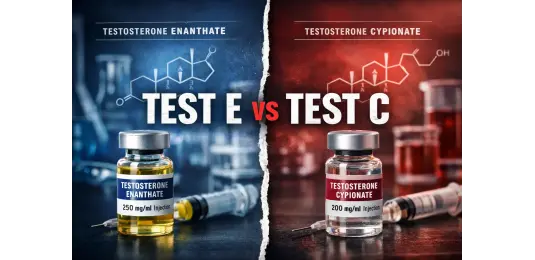
Testosterone Enanthate and Testosterone Cypionate are often treated as identical. They are not. The active hormone is the same - but carrier oil, half-life, estradiol response, and regional availability create real practical differences that affect how a cycle feels and how it is managed.
What the Ester Actually Does
An ester is a chemical chain attached to the testosterone molecule. It makes the hormone oil-soluble and controls how fast it releases from the injection depot into systemic circulation. The ester itself is cleaved by enzymes once in the bloodstream - what remains is identical free testosterone.
The key difference between Enanthate and Cypionate is the length of that chain:
| Property | Testosterone Enanthate | Testosterone Cypionate |
|---|---|---|
| Ester | Heptanoate (7 carbons) | Cyclopentylpropionate (8 carbons) |
| Half-life | 5 - 7 days | 7 - 8 days Longer |
| Active testosterone per 100mg | 69.9mg More | 69.5mg |
| Molecular weight | 400.6 g/mol | 412.6 g/mol |
| Carrier oil (typical) | Sesame oil | Cottonseed oil |
| Primary market | Europe, global | USA dominant |
| Injection frequency | E5D - E7D | E7D - E10D Less frequent |
Carrier Oil: The Difference Nobody Talks About
This is the most under-discussed practical difference between the two compounds - and the one most likely to affect real-world experience.
- Thicker viscosity
- Slightly higher PIP risk at cold temperatures
- Sesame allergy contraindication (~0.1% population)
- Historically more common in European pharmacy production
- Slightly slower draw into syringe
- Lower viscosity - easier injection
- Less PIP at room temperature
- Cottonseed allergy rare but documented
- Standard in US pharmaceutical production (Depo-Testosterone)
- Faster draw, smoother push
Blood Level Curves: What the Numbers Mean in Practice
The half-life difference of roughly 1 - 2 days creates a meaningful difference in peak-to-trough ratio - especially relevant when injecting once per week.
| Injection Schedule | Enanthate Peak-Trough Variance | Cypionate Peak-Trough Variance |
|---|---|---|
| Once per week (E7D) | Higher variance - noticeable trough by day 6 - 7 | Lower variance - more stable through day 7 Better |
| Twice per week (E3.5D) | Stable - variance minimal Equal | Stable - variance minimal Equal |
| Every 5 days (E5D) | Good stability | Excellent stability Slightly better |
Estrogen, Libido and Muscle: Where Real Differences Emerge
This is the section that most comparison articles skip entirely - and where user experience actually diverges.
| Outcome | Enanthate | Cypionate |
|---|---|---|
| Estradiol levels (clinical data) | Marginally lower Better | Marginally higher |
| Hematocrit elevation | Lower in clinical comparison Safer | Slightly higher elevation |
| Muscle anabolism (reported) | Slightly less anabolic per user reports | Reported as more anabolic by users Edge |
| Libido and erectile function | Reported better for libido/ED Edge | Slightly less libido benefit per reports |
| Mood stability | Reported as more stable | Similar - depends on frequency |
Aromatization: Same Hormone, Same Rules
Both compounds aromatize at identical rates - because after ester cleavage, the molecule is the same. The variables that drive estrogen conversion have nothing to do with the ester:
| Factor | Effect on Estrogen | Ester Dependent? |
|---|---|---|
| Total testosterone dose | Higher dose = more aromatization | No |
| Body fat percentage | More fat = more aromatase enzyme | No |
| Injection frequency | Peaks drive more conversion | No |
| Genetics | Individual aromatase activity varies | No |
| Ester choice | Negligible - same active hormone | Yes - but irrelevant |
For complete estrogen management protocol see estrogen control on cycle and aromatase inhibitors on TRT and steroids.
Typical Protocols: Dosage and Injection Schedule
For structured cycle planning by goal see Cycles by Goal. For PCT protocol after cycle see PCT after steroids: Clomid, Nolvadex and HCG.
Health Monitoring: What to Track and When
The ester choice does not change the monitoring requirements. Both compounds require the same bloodwork schedule:
| Marker | When to Test | Action if Elevated |
|---|---|---|
| Total & Free Testosterone | Week 6 - 8 after stable dose | Adjust dose |
| Estradiol (E2) | Week 4 - 6 | AI - see AI guide |
| Hematocrit | Every 3 months | Donate blood if >52% · See hematocrit guide |
| Lipids (LDL/HDL) | Baseline + 3 months | Dietary intervention · See cholesterol guide |
| Blood Pressure | Monthly | Protocol adjustment · See BP guide |
Who Should Choose What
- Outside the US - better availability
- Priority is libido and erectile function
- Lower estradiol baseline preferred
- Injecting twice per week anyway
- Sesame oil tolerated without reaction
- US-based - standard clinical availability
- Priority is muscle anabolism
- Prefer once-weekly injection
- Cottonseed oil well tolerated
- Smoother injection experience preferred
Bottom Line
- Active hormone is identical - anabolic effect at equal doses is the same
- Cypionate has a 1 - 2 day longer half-life - meaningful only when injecting once per week
- Enanthate shows marginally lower estradiol and hematocrit in clinical data
- Cypionate reported as slightly more anabolic by users; Enanthate better for libido
- Carrier oil difference (sesame vs cottonseed) affects injection experience and allergy risk
- For twice-weekly injection protocols - the compounds are functionally identical
- Availability by region is the most practical deciding factor for most users
Relevant Compounds
Testosterone Enanthate vs Cypionate - Common Questions
What is the difference between enanthate and cypionate?
Almost none in effect - both are long testosterone esters with nearly identical release profiles; the choice is mostly preference and availability.
How often should each be injected?
Once or twice a week for both; the article compares stability patterns.
Which is better for a first cycle?
Either works; most pick what is in stock. The reference first cycle is 250-500 mg per week of one ester.
Do they differ in water retention?
No meaningful difference - both aromatize equally at the same weekly dose.
Which has a longer half-life?
Cypionate is marginally longer on paper; in practice the difference is irrelevant to dosing.
When does PCT start after either?
About two weeks after the last injection for both.
Keep Reading
Testosterone Propionate Vs Enanthate
Testosterone Undecanoate Vs Enanthate Trt
Sustanon Vs Test Enanthate