Overtraining on TRT and Steroids: Signs, Symptoms, and Recovery
  • By Ethan Cole
  • June 9, 2026
  • Reading Time: 13 mins
Overtraining on TRT and Steroids: Signs, Symptoms, and Recovery
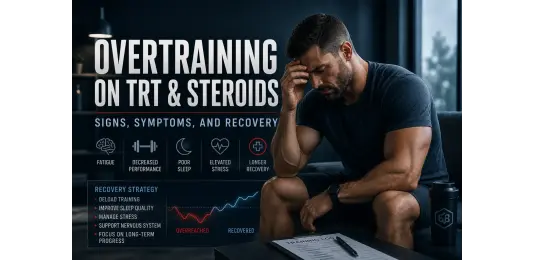
Recovery & Performance

Overtraining on TRT and Steroids: Signs, Symptoms, and Recovery

Overtraining on TRT and steroids is one of the most misunderstood subjects in performance enhancement. Many athletes understand that training creates progress, but far fewer understand that recovery ultimately determines whether training stress becomes adaptation or accumulated fatigue.

A common belief within bodybuilding is that anabolic steroids dramatically increase recovery capacity. While recovery capacity may improve under certain circumstances, the idea that recovery becomes unlimited is simply not true.

The human body continues to operate within biological limits regardless of hormone status. Sleep still matters. Nutrition still matters. Psychological stress still matters. Training volume still matters.

This is why overtraining on TRT and steroids deserves serious discussion. Athletes often focus on compounds, dosages, and training intensity while overlooking the factors that determine whether those efforts can actually be sustained.

Many situations that athletes describe as "needing stronger compounds" are actually situations where recovery capacity has been exceeded.

Understanding how fatigue accumulates allows athletes to train more effectively, recover more consistently, and maintain progress over longer periods of time.

Quick Summary

  • Overtraining is different from normal fatigue.
  • Steroids may improve recovery capacity but do not eliminate recovery needs.
  • Sleep remains one of the most important recovery variables.
  • Psychological stress contributes to total fatigue load.
  • Poor recovery often develops gradually rather than suddenly.
  • Bloodwork may help identify recovery-related health issues.
  • Long-term progress depends on balancing stress and recovery.

What Overtraining Actually Means

The word overtraining is often used incorrectly.

Many athletes describe a difficult workout, temporary soreness, or a few days of fatigue as overtraining. In reality, true overtraining is far more complex.

Most productive training programs intentionally create fatigue. Fatigue itself is not the problem.

The problem occurs when fatigue accumulates faster than recovery can occur for prolonged periods.

Overtraining on TRT and steroids develops when training demands repeatedly exceed the body's ability to adapt.

This process rarely happens overnight. Instead, fatigue gradually accumulates until performance, recovery quality, motivation, and overall well-being begin to decline.

Understanding this distinction is important because many athletes either ignore early warning signs or incorrectly assume they are overtrained when they are simply experiencing normal training fatigue.

Normal Fatigue vs Recovery Failure

Every productive training session creates some level of fatigue.

Muscles become damaged. Energy stores become depleted. The nervous system experiences stress. Recovery processes begin.

Under normal circumstances, the body adapts successfully.

Performance improves. Strength increases. Muscle growth occurs. Training continues.

Recovery failure occurs when the balance between stress and adaptation begins shifting in the wrong direction.

Instead of recovering from training stress, fatigue starts accumulating faster than it can be removed.

This process often begins subtly.

An athlete may notice reduced motivation, lower training performance, disrupted sleep, slower recovery between sessions, or unusual levels of exhaustion.

These signs are often ignored because athletes assume they simply need to push harder.

Why Steroids Do Not Prevent Overtraining

One of the biggest myths in bodybuilding is that anabolic steroids eliminate recovery limitations.

This misconception often develops because enhanced athletes can sometimes tolerate more training volume than they could previously.

Improved recovery capacity, however, does not mean unlimited recovery capacity.

Connective tissue still experiences stress. The nervous system still experiences fatigue. Sleep deprivation still affects performance. Psychological stress still influences recovery.

Overtraining on TRT and steroids remains possible because recovery involves far more than muscle tissue alone.

Many athletes become trapped in a cycle where improved recovery encourages additional workload. More volume is added. More exercises are added. More training days are added.

Eventually fatigue begins accumulating despite continued effort.

The body always maintains limits, even when recovery capacity improves.

Overtraining vs Overreaching

Another source of confusion is the difference between overtraining and overreaching.

Functional overreaching is often used intentionally within structured training plans.

Training stress temporarily exceeds recovery capacity, creating short-term fatigue. Recovery is then prioritized and performance often rebounds above previous levels.

This process can be useful when carefully managed.

Overtraining is different.

Overtraining on TRT and steroids involves a prolonged state of recovery failure where fatigue continues accumulating without adequate restoration.

Instead of experiencing a temporary decline followed by improvement, performance often stagnates or worsens.

The athlete continues working harder while results become increasingly difficult to achieve.

Related reading:

Recovery on TRT and Steroids

How Fatigue Accumulates Over Time

Fatigue rarely originates from a single source.

Training stress combines with sleep quality, work demands, family responsibilities, travel, nutrition, illness, hydration status, and psychological pressure.

The body responds to total stress load rather than individual stressors in isolation.

This is one reason two athletes following identical programs may experience very different recovery outcomes.

One athlete may recover effectively while another accumulates fatigue despite performing the same workouts.

The difference often lies outside the gym.

Understanding total stress load is essential when evaluating overtraining on TRT and steroids because recovery capacity depends on much more than hormone levels alone.

Physical Signs of Overtraining

One reason overtraining on TRT and steroids can be difficult to recognize is that symptoms often develop gradually.

Most athletes do not wake up one morning feeling dramatically overtrained. Instead, recovery quality slowly declines while fatigue steadily accumulates.

The earliest signs are frequently subtle.

Performance may stop improving despite continued effort. Recovery between workouts may take longer than expected. Motivation may decline. Sleep quality may become inconsistent.

Over time, additional symptoms often appear.

  • Persistent fatigue
  • Reduced strength progression
  • Decreased workout performance
  • Longer recovery times
  • Higher perceived effort during normal workouts
  • Frequent soreness
  • Reduced training motivation
  • Lower energy throughout the day
  • Increased susceptibility to illness

None of these symptoms automatically confirm overtraining, but clusters of symptoms often provide useful warning signs.

The important point is recognizing patterns before fatigue becomes severe.

Psychological Symptoms Are Often Missed

Many athletes expect overtraining symptoms to be entirely physical.

In reality, psychological symptoms are often among the earliest indicators that recovery capacity is becoming overwhelmed.

Recovery involves the nervous system as much as the muscular system.

As fatigue accumulates, athletes may notice:

  • Reduced motivation
  • Loss of enthusiasm for training
  • Increased irritability
  • Poor concentration
  • Mood instability
  • Difficulty relaxing
  • Mental fatigue
  • Loss of confidence in performance

These symptoms are frequently misinterpreted.

Many athletes assume they need greater discipline when the real issue is excessive accumulated fatigue.

This is one reason overtraining on TRT and steroids should never be evaluated exclusively through physical symptoms.

Sleep Problems Often Appear Early

Sleep and recovery are tightly connected.

As fatigue accumulates, sleep quality often begins to change.

Some athletes experience difficulty falling asleep. Others wake repeatedly throughout the night. Some sleep longer yet continue feeling exhausted.

This creates a frustrating cycle.

Poor recovery contributes to poor sleep. Poor sleep then further reduces recovery capacity.

Overtraining on TRT and steroids frequently becomes much easier to identify when sleep patterns are monitored honestly.

Changes in sleep quality often appear before major performance declines become obvious.

This is one reason sleep remains one of the most valuable recovery metrics available to athletes.

Related reading:

Sleep on TRT and Steroids

Cortisol, Stress, and Recovery Failure

Recovery discussions often lead to conversations about cortisol.

This is understandable because cortisol plays a major role in stress adaptation.

However, cortisol is often blamed for problems that originate elsewhere.

When training volume becomes excessive, sleep quality declines, psychological stress rises, and recovery resources become depleted, stress-related responses naturally become more noticeable.

The goal is not eliminating cortisol.

The goal is improving the recovery environment.

Overtraining on TRT and steroids usually becomes easier to manage when athletes focus on recovery fundamentals rather than searching for a single hormonal explanation.

Sleep quality, workload management, nutrition, hydration, and stress control often produce larger benefits than expected.

Related reading:

Cortisol on TRT and Steroids

Bloodwork Can Provide Valuable Context

Bloodwork cannot diagnose every recovery problem, but it can provide useful information when fatigue becomes persistent.

Objective data often helps identify issues that may contribute to poor performance or reduced recovery quality.

Depending on the situation, athletes may evaluate:

  • Total Testosterone
  • Free Testosterone
  • Estradiol
  • SHBG
  • Hematocrit
  • Hemoglobin
  • Thyroid markers
  • Glucose-related markers
  • Lipid markers

Bloodwork should not replace common sense, but it often provides a clearer picture of overall health status.

When recovery remains poor despite reasonable sleep, nutrition, and training practices, objective monitoring becomes increasingly valuable.

Overreaching vs Overtraining Comparison

Condition Recovery Time Performance Impact Typical Outcome
Normal Training Fatigue 24–72 Hours Minimal Positive Adaptation
Functional Overreaching Several Days Temporary Decline Performance Rebound
Chronic Under-Recovery Weeks Moderate Decline Stalled Progress
Overtraining Syndrome Months Severe Decline Long Recovery Period

Recovery Capacity Is Not Unlimited

One of the most important concepts in performance enhancement is understanding recovery capacity.

Every athlete possesses a finite ability to recover from stress.

Training consumes recovery resources. Life stress consumes recovery resources. Poor sleep consumes recovery resources.

Overtraining on TRT and steroids develops when total demands repeatedly exceed available recovery capacity.

This is why more effort is not always the answer.

Sometimes progress improves not because training becomes harder, but because recovery becomes better.

The strongest athletes are rarely those who ignore recovery. They are often the athletes who manage recovery most effectively.

How to Recover From Overtraining

The first step in recovering from overtraining on TRT and steroids is recognizing that more effort is not always the solution.

Many athletes respond to stalled progress by increasing workload. They add more sets, more exercises, more cardio, or additional training days. Unfortunately, these adjustments often increase fatigue further.

Recovery begins when total stress is reduced to a level the body can successfully adapt to.

This does not necessarily mean complete inactivity.

In many situations, reducing training volume, improving sleep quality, managing stress, and restoring proper nutrition provide significant benefits.

The objective is restoring the balance between training demands and recovery capacity.

Once recovery resources become available again, performance often begins improving naturally.

Why Less Training Sometimes Produces Better Results

This concept can be difficult for motivated athletes to accept.

Hard work is rewarded in many areas of life. As a result, athletes often assume that more training automatically produces better outcomes.

Human physiology does not always follow that rule.

Muscle growth, strength gains, and performance improvements depend on adaptation rather than effort alone.

If fatigue continually exceeds recovery capacity, adaptation becomes increasingly difficult regardless of how hard someone trains.

Overtraining on TRT and steroids frequently develops because athletes continue increasing stress while recovery quality remains unchanged.

In these situations, reducing workload may improve progress faster than increasing workload.

The goal is not doing less forever. The goal is creating conditions where adaptation can occur efficiently again.

The Role of Nutrition in Recovery

Nutrition is often discussed in terms of muscle growth and body composition, but it also plays a major role in recovery.

Insufficient calorie intake, inadequate protein consumption, poor hydration, and inconsistent eating patterns can all reduce recovery quality.

Many athletes underestimate how much recovery depends on consistent nutritional support.

Training creates demand. Nutrition helps provide resources required for adaptation.

This is one reason overtraining on TRT and steroids should always be evaluated within the broader context of recovery habits.

Training stress without adequate recovery support eventually becomes difficult to sustain.

When a Deload May Be Helpful

A deload is a planned reduction in training stress designed to facilitate recovery.

Deloads may involve lower volume, lower intensity, fewer exercises, or a combination of all three.

The purpose is not losing progress.

The purpose is reducing accumulated fatigue.

Many athletes discover that performance improves after periods of reduced workload because recovery finally catches up with training demands.

This concept often surprises athletes who believe continuous hard training is always optimal.

In reality, strategic recovery is frequently part of successful long-term performance development.

Common Mistakes Athletes Make

Ignoring Early Warning Signs

Many athletes continue pushing harder despite obvious signs of declining recovery.

Fatigue, poor sleep, reduced motivation, and stalled performance often appear long before severe recovery failure develops.

Assuming More Drugs Solve Recovery Problems

One of the most common mistakes in performance-enhancement communities is attempting to solve recovery issues through additional compounds.

When the underlying problem involves sleep, stress, workload, or recovery management, stronger drugs rarely solve the root issue.

Confusing Discipline With Recovery Capacity

Discipline is valuable.

However, discipline cannot completely override biological recovery limits.

The body still requires adequate recovery resources regardless of motivation.

Neglecting Sleep

Sleep remains one of the highest-return recovery tools available.

Athletes often spend far more time optimizing supplements than optimizing sleep quality.

Evaluating Recovery Only Through Muscle Soreness

Recovery involves much more than muscle soreness.

Nervous system fatigue, psychological stress, sleep quality, and overall well-being often provide equally valuable information.

The Goal Is Sustainable Progress

The discussion around overtraining on TRT and steroids ultimately comes down to sustainability.

Most athletes can push extremely hard for short periods of time.

The greater challenge is maintaining high-quality performance for months and years.

Sustainable progress requires balancing stress and recovery effectively.

Training provides the stimulus. Recovery provides the adaptation.

Neither can function optimally without the other.

This is why the strongest long-term athletes often become experts at managing recovery rather than simply increasing effort.

Consistency tends to outperform short bursts of unsustainable intensity.

Related Recovery & Performance Guides

Practical Takeaway

Overtraining on TRT and steroids is not caused by training alone. It develops when total stress repeatedly exceeds recovery capacity for prolonged periods of time.

Steroids may improve recovery capacity under certain circumstances, but they do not eliminate biological limits. Sleep, nutrition, stress management, workload planning, and overall health remain critical factors.

The athletes who achieve the most consistent long-term success are rarely the athletes who train the hardest every day. They are often the athletes who recover most effectively.

Understanding fatigue, recovery, and adaptation allows athletes to make better decisions and maintain progress without constantly fighting their own physiology.

Recovery is not the opposite of training. Recovery is part of training.

Frequently Asked Questions

Q: Can you become overtrained while using steroids?

Yes. Steroids may improve recovery capacity, but they do not eliminate recovery requirements or biological limits.

Q: What is the difference between overreaching and overtraining?

Overreaching is usually temporary and can be planned. Overtraining involves prolonged recovery failure and declining performance.

Q: What are the first signs of overtraining?

Common early signs include poor recovery, reduced motivation, declining performance, persistent fatigue, and sleep disturbances.

Q: Can poor sleep contribute to overtraining?

Yes. Sleep quality strongly influences recovery capacity and adaptation from training stress.

Q: How long does recovery from overtraining take?

Recovery time varies depending on severity. Mild cases may improve within days or weeks, while severe cases can require significantly longer.

Q: Is more training always better for muscle growth?

No. Muscle growth depends on balancing training stress with adequate recovery resources.