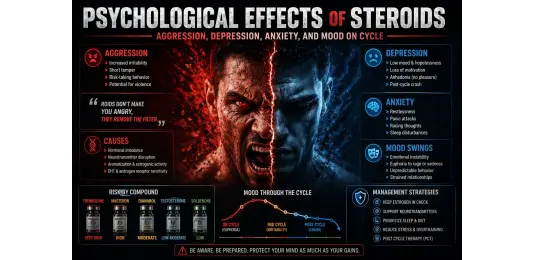
Psychological Effects of Steroids
How Androgens Affect the Brain: The Neurological Mechanism
Androgen receptors are present throughout the central nervous system — in the amygdala, hypothalamus, prefrontal cortex, hippocampus, and brainstem. Endogenous testosterone has established roles in mood regulation, motivation, aggression, libido, and cognitive function. When exogenous androgens are introduced at supraphysiological doses, they bind to these receptors at levels far exceeding normal physiological exposure, producing effects that extend beyond the musculoskeletal system into neurological and psychological territory.
The brain's response to supraphysiological androgen exposure operates through multiple pathways: direct androgen receptor activation in limbic and subcortical circuits (aggression, reward); modulation of serotonin, dopamine, and GABA neurotransmitter systems; effects mediated by estrogen via aromatisation (since estrogen itself has profound effects on mood and neurological function); and indirect effects from hormonal disruption — suppressed endogenous testosterone, altered prolactin, and disrupted sleep from thermoregulatory side effects covered at Night Sweats on Steroids.
Aggression and "Roid Rage": Evidence vs. Reality
The popular concept of "roid rage" — a steroid-induced state of uncontrollable violent behaviour — is not supported by clinical evidence at the doses that represent the majority of performance athlete use. What the evidence does support is a genuine, dose-dependent increase in irritability, dominance behaviour, and reduced frustration tolerance — a lowering of the aggression threshold rather than the creation of unprovoked violence in previously non-aggressive individuals.
The most androgenically extreme compound in the British Dragon catalog — Halotestex Tablets (Fluoxymesterone, androgenic index ~1,900) — produces the most pronounced androgenic CNS stimulation of any oral compound. Athletes with pre-existing aggression-prone psychology or impulse control challenges are at genuinely elevated risk of clinically significant mood dysregulation on high-androgenic protocols. Athletes with stable baseline psychology and strong situational awareness typically experience a shift in competitive drive and assertiveness that is not socially disruptive at moderate doses.
The aggression profile of Trenbolone is distinct from high-androgenic orals and is covered in detail at Trenbolone Side Effects — it operates through a different CNS mechanism (dopaminergic/noradrenergic stimulation) rather than direct androgenic receptor saturation, and the psychological effect profile reflects this difference.
Anxiety, Paranoia, and CNS Overstimulation
CNS stimulant effects from highly androgenic compounds — and separately from thermogenic ancillaries — can produce a baseline elevation of anxiety that ranges from subclinical heightened alertness to genuine anxiety disorder presentation in susceptible athletes. The mechanism involves androgenic stimulation of noradrenergic pathways and, in some compounds, direct interference with GABAergic inhibitory tone.
Paranoid ideation — a pattern of hypervigilant threat-interpretation — is reported most consistently with Trenbolone at higher doses and is not typically associated with testosterone or most oral compounds. It is thought to reflect Trenbolone's specific binding profile at neurological androgen and progestogen receptors rather than a generalised high-androgenic effect.
The sleep disruption that thermogenic compounds and Trenbolone produce — detailed at Night Sweats on Steroids — compounds psychological instability significantly. Sleep deprivation at the scale produced by severe night sweats and insomnia produces anxiety, emotional dysregulation, and paranoid cognition independently of any pharmacological mechanism. Separating compound-driven psychological effects from sleep-deprivation-driven effects is clinically important and often impossible without addressing both simultaneously.
Depression: Three Distinct Mechanisms on Cycle
Depression during or after a steroid cycle can originate from three mechanistically distinct sources, each requiring a different management approach:
- Prolactin-driven depression: Elevated prolactin — the consequence of progestogenic compounds including Nandrolone (in Decabol 250) — directly suppresses dopamine and produces anhedonia, low motivation, and depressive symptomatology. This is pharmacologically addressable with Cabergoline and should resolve when prolactin is normalised. The prolactin pathway is covered at Trenbolone Side Effects in the context of the most prolactinogenic compound group.
- Estrogen-crash depression: This is the most commonly mismanaged psychological side effect in performance pharmacology. Estrogen is not an exclusively "female" hormone — it has critical functions in the male brain including mood regulation, serotonin sensitivity, and cognitive function. Athletes who over-suppress estrogen with excessive aromatase inhibitor dosing — driving estradiol below physiological range — can experience severe depression, anhedonia, and emotional blunting that is frequently misattributed to the anabolic compounds rather than the AI over-suppression. Managing aromatase inhibitors correctly — targeting mid-range rather than near-zero estradiol — is one of the most important psychological protections on a cycle. See the estrogen section below for specific management.
- HPTA suppression depression: The most common form of post-cycle depression. As exogenous androgens clear, endogenous testosterone production has not yet recovered — leaving the athlete in a low-testosterone, low-estrogen state that produces the classic symptom cluster: low mood, fatigue, loss of motivation, poor libido, and emotional flatness. This is a physiological state with a pharmacological solution, covered fully at HPTA Suppression on Steroids. Correctly timed and dosed PCT dramatically shortens this window.
The Estrogen-Mood Connection: Aromatase Inhibitor Over-Suppression
The role of estrogen in male mood and neurological function is substantially underappreciated in performance pharmacology communities. Estradiol modulates serotonin receptor sensitivity, supports neuroplasticity, regulates sleep architecture (independent of testosterone), and contributes to emotional resilience. In high-testosterone cycles where aromatisation produces elevated estradiol, appropriate use of an aromatase inhibitor targets a range that avoids both estrogenic side effects (gynecomastia, water retention) and estrogen-deficiency symptoms (joint pain, mood depression, cognitive impairment).
The common error is pursuing near-zero estradiol as a goal — a practice driven by oversimplified "estrogen bad" reasoning. Athletes running Exemestane Tablets (Aromasin) or Anastrozole 1 mg at doses that drive estradiol below 15–20 pg/mL typically report the following: worsening joint pain, depression and anhedonia, poor sleep, reduced cognitive sharpness, and libido collapse. These symptoms often persist and worsen while AI dosing continues, and can be mistaken for other causes. The correct response is AI dose reduction, not compound changes or antidepressant addition.
Bloodwork is the only reliable guide to AI dosing calibration. Targeting estradiol in the 20–35 pg/mL range on high-testosterone cycles maintains the neurological and joint-protective functions of estrogen while controlling estrogenic side effect risk. Running bloodwork every 4–6 weeks during a cycle that includes an AI is the standard for identifying over-suppression before it produces sustained psychological impact.
Post-Cycle Depression: The Predictable Crash
Post-cycle depression is not a rare adverse event — it is a predictable physiological consequence of HPTA suppression during the cycle followed by the lag period before endogenous testosterone recovers. In athletes running effective PCT with appropriately timed Clomiphene Tablets and Tamoxifen Tablets, the recovery window — and the associated mood trough — is typically 3–6 weeks. Without PCT, the low-testosterone state can persist for months, with corresponding psychological impact throughout that period.
The relationship between cycle length, suppression severity, and post-cycle psychological impact is direct: longer cycles with more suppressive compounds produce deeper and longer low-testosterone troughs post-cycle. This is one of the most practically important reasons to manage cycle length conservatively and run structured PCT — not only for the physiological recovery of the axis, but because the psychological cost of a prolonged post-cycle trough significantly impacts quality of life and training continuity. The complete PCT framework is at PCT After Steroids: Clomid, Nolvadex, HCG.
Compound Risk Hierarchy for Psychological Side Effects
- Highest psychological risk: Trenbolone compounds (CNS stimulation, paranoid ideation, dopaminergic disruption — see Trenbolone Side Effects); Halotestex Tablets (extreme androgenic CNS stimulation, aggression elevation); high-dose AI use producing estrogen crash (any cycle with aggressive aromatase inhibitor use)
- Moderate psychological risk: Nandrolone-based compounds via prolactin elevation and progestogenic depression; high-dose testosterone without estrogen calibration; Oxydrol Tablets (Oxymetholone) — reported mood volatility not fully explained by androgenic or estrogenic pathways
- Lower psychological risk: Oxandrolone, Methenolone, Boldenone-based cycles — lower CNS androgenic stimulation, moderate HPTA suppression, better tolerance for athletes with psychological sensitivities. These remain suppressive and produce post-cycle effects, but the on-cycle neurological impact is substantially less than highly androgenic or progestogenic compounds
Conclusion
The psychological effects of steroids span a spectrum from mild mood enhancement to clinically significant depression, anxiety, and aggression — and the driver of each effect is compound-specific and mechanism-specific. Androgenic CNS overstimulation, prolactin elevation, estrogen crash from AI over-suppression, and post-cycle testosterone trough are four distinct problems with four distinct solutions. Conflating them produces both under-management of genuine risks and over-attribution of effects to the wrong cause. Understanding which mechanism applies at any given point in a cycle is the prerequisite for effective management — and for making informed decisions about compound selection before the cycle begins.
FAQ
Q1. Do steroids cause depression?
Yes — through multiple distinct mechanisms depending on cycle phase and compounds used. On cycle, depression can result from prolactin elevation (progestogenic compounds like Nandrolone), estrogen over-suppression from excessive aromatase inhibitor use, or sleep deprivation from thermoregulatory side effects. Post-cycle, depression results from the HPTA suppression trough — the period between exogenous compound clearance and endogenous testosterone recovery. Each mechanism has a specific intervention: Cabergoline for prolactin-driven depression; AI dose reduction for estrogen-crash depression; correctly timed PCT with Clomiphene Tablets and Tamoxifen Tablets for post-cycle recovery. Attributing depression to the wrong cause leads to ineffective management. Q2. Is "roid rage" real or a media myth?
The severe uncontrollable violence implied by "roid rage" in popular media is not supported by clinical evidence at typical performance doses. What is real is a dose-dependent increase in irritability, reduced frustration tolerance, and lowered aggression threshold — the genuine pharmacological effect of supraphysiological androgenic CNS stimulation. In athletes with pre-existing impulse control issues or aggression-prone psychology, this genuine threshold reduction can produce clinically significant mood dysregulation. In psychologically stable athletes at moderate doses, it typically manifests as increased competitive drive and assertiveness without social or behavioural disruption. The highest-risk compounds for this effect are Halotestex Tablets and high-dose Trenbolone compounds. Q3. Which steroid compounds carry the highest risk for psychological side effects?
The risk hierarchy is: Trenbolone compounds (dopaminergic disruption, CNS stimulation, paranoid ideation in susceptible individuals, sleep disruption compounding all effects); Halotestex Tablets (extreme androgenic CNS stimulation, highest androgenic-to-anabolic ratio of any compound); Nandrolone-based compounds via prolactin elevation (Decabol 250, Durabol 100); and any cycle with aggressive AI use producing estrogen crash. Lower psychological risk compounds include Oxandrolone (Oxanabol Tablets), Methenolone (Primobol Inject), and Boldenone — which produce meaningful HPTA suppression but significantly less neurological androgenic stimulation on cycle. Q4. How do aromatase inhibitors affect mood on cycle?
Aromatase inhibitors (Exemestane Tablets, Anastrozole 1 mg) affect mood through their impact on estradiol levels. Used correctly to target mid-range estradiol (20–35 pg/mL), they prevent estrogenic side effects while preserving estrogen's neurological functions — mood stability, serotonin sensitivity, sleep quality, and cognitive sharpness. Over-suppressed below 15–20 pg/mL, they produce estrogen-deficiency depression, anhedonia, emotional blunting, and cognitive impairment that can be severe and persistent. This is the most commonly misdiagnosed psychological side effect in performance pharmacology — the depression from AI over-suppression is often attributed to the anabolic compounds rather than the AI. Bloodwork-guided dosing is the only reliable approach. Q5. How long does post-cycle depression last and what helps?
With properly timed PCT using Clomiphene Tablets and Tamoxifen Tablets, the psychological trough of post-cycle depression typically lasts 3–6 weeks as LH/FSH and natural testosterone recovery progress. Without PCT, it can persist for 3–6 months or longer in severe suppression cases. The most effective interventions are: beginning PCT at the correct time relative to the last injection (ester-specific timing); using a dual-SERM protocol (Clomiphene + Tamoxifen) for strong LH stimulation; maintaining training continuity throughout PCT (exercise independently supports mood and testosterone recovery); and monitoring recovery progress with bloodwork at 4 and 8 weeks post-PCT to confirm the trajectory. Melatonin and sleep optimisation support sleep quality throughout the recovery window, which in turn accelerates hormonal and psychological normalisation.