HPTA Suppression on Steroids

  • By Dr. Miranda Bails
  • April 13, 2026
  • Reading Time: 10 mins
HPTA Suppression on Steroids
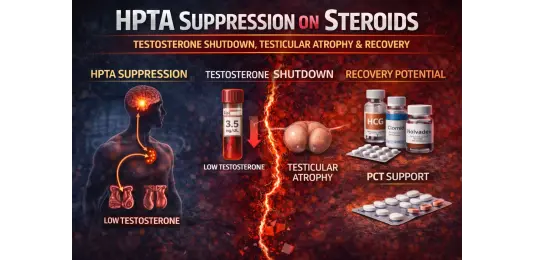
What Is the HPTA and Why It Matters

The Hypothalamic-Pituitary-Testicular Axis (HPTA) is the hormonal feedback system that regulates endogenous testosterone production. The hypothalamus releases gonadotropin-releasing hormone (GnRH) in pulses, which signals the pituitary gland to release luteinising hormone (LH) and follicle-stimulating hormone (FSH). LH signals the Leydig cells in the testes to produce testosterone; FSH supports spermatogenesis and overall testicular function. When testosterone levels are adequate, negative feedback suppresses GnRH and LH release — the system regulates itself.

Exogenous androgens — all anabolic steroids, regardless of the compound — introduce testosterone or testosterone-like androgens from outside the body. The hypothalamus and pituitary detect elevated androgen levels and respond the same way they would to excess endogenous testosterone: they reduce GnRH, LH, and FSH output. The testes, receiving no LH signal, reduce and eventually cease testosterone production entirely. This is HPTA suppression, and it begins within days of the first administration for most compounds.

How Exogenous Androgens Suppress the Axis: The Negative Feedback Loop

The suppression mechanism has two primary drivers:

  • Direct androgenic feedback: Androgens at the hypothalamus and pituitary receptors suppress GnRH and LH release. All exogenous testosterone compounds — including Testabol Depot (Testosterone Cypionate) and the other esters in the Testabol range — provide this feedback directly. The higher the circulating androgen level relative to the physiological range, the more complete the suppression.
  • Estrogenic feedback: Testosterone aromatises to estradiol, which exerts its own potent negative feedback on the hypothalamic-pituitary axis — independent of the androgenic signal. Compounds with high aromatisation rates (testosterone, Methandrostenolone in Methanabol 10 and Methanabol) produce suppression through both the androgenic and estrogenic pathways simultaneously, making their HPTA suppression more complete than the androgenic effect alone would produce. This is why managing estrogen during a cycle — covered in detail at Estrogen Control on Cycle — also has downstream relevance for the speed of HPTA recovery post-cycle.

The result at the testicular level: with LH absent, Leydig cells reduce steroidogenic enzyme activity. Testicular testosterone output falls to near zero. Without FSH, Sertoli cell function — which supports spermatogenesis and intratesticular testosterone — is also compromised. The testes are, functionally, offline for the duration of the cycle.

What Determines How Hard Your HPTA Gets Suppressed

Not all suppression is equal. The severity and duration are determined by several factors:

  • Compound androgenicity and aromatisation: Compounds with both high androgenic activity and high aromatisation — testosterone-based and Methandrostenolone-based cycles — produce the most complete suppression through dual-pathway feedback. Compounds with moderate androgenicity and no aromatisation (Oxandrolone, Methenolone) produce meaningful but comparatively softer suppression. No anabolic androgenic steroid is HPTA-neutral.
  • Dose: Higher doses produce faster onset of complete suppression and extend the duration of recovery. At clinical testosterone replacement doses, suppression is near-complete; at performance doses it is complete within the first week for most compounds.
  • Cycle length: This is the most critical recovery variable. A 6-week cycle produces significantly less Leydig cell atrophy than a 16-week cycle. Extended cycles — particularly those incorporating highly suppressive compounds across multiple months — can produce secondary hypogonadism that requires longer and more aggressive PCT intervention to resolve. See the PCT guide for complete recovery protocol timelines by cycle length.
  • Compound half-life: Long-ester compounds (Testosterone Cypionate in Testabol Depot, Testosterone Enanthate) remain active for 2–3 weeks after the final injection, meaning the HPTA cannot begin to recover until compound levels fall below suppressive thresholds. Short-ester compounds (Aquabol Suspension, Testosterone Propionate) clear in days — PCT can begin sooner and recovery onset is earlier. This ester-specific PCT timing is explained fully in the PCT guide.

Testicular Atrophy: The Physical Manifestation of HPTA Suppression

Testicular atrophy — the reduction in testicular volume during a cycle — is the direct physical consequence of LH absence. Without LH signalling and the intratesticular testosterone it stimulates, testicular tissue reduces in volume. Leydig cells, which require continuous LH pulsation to maintain their morphology, undergo functional and structural regression during extended suppression.

The degree of atrophy is cycle-length dependent. A 6–8 week cycle typically produces mild-to-moderate volume reduction that recovers relatively quickly post-cycle. A 20+ week cycle with no testicular stimulation can produce severe Leydig cell desensitisation that extends recovery to 12 months or beyond — in extreme cases permanently compromising natural testosterone output. This is not a theoretical risk for athletes who run continuous or very long cycles without intracycle HCG use.

Testicular atrophy is also directly related to fertility impairment during and after the cycle — FSH suppression halts spermatogenesis independently of the testosterone and LH effects. Athletes with fertility goals require specific management that goes beyond standard PCT. Note that androgenic side effects during cycles — including hair effects covered in Hair Loss on Steroids — are mechanistically distinct from HPTA suppression, though both occur simultaneously in high-androgenic cycles.

HCG During Cycle: Preserving Testicular Function

Human chorionic gonadotropin (HCG) mimics LH at the LH receptor in Leydig cells. During a cycle — when endogenous LH is suppressed to near zero — HCG provides the LH-like signal that maintains Leydig cell function, intratesticular testosterone production, and testicular volume. It does not restart the HPTA (the hypothalamic-pituitary component remains suppressed by exogenous androgens) but it prevents the Leydig cell atrophy that would otherwise accumulate across the cycle length.

  • Dosing: HCG 2,500 IU or HCG 5,000 IU vials, administered at 250–500 IU twice weekly throughout the cycle. This frequency maintains continuous Leydig cell stimulation without desensitising the LH receptor — which occurs with very high doses or very frequent administration.
  • When to use it: Cycles of 10 weeks or longer, any cycle including highly suppressive compounds (Trenbolone blends, Nandrolone, high-dose testosterone), and any athlete with fertility considerations. Shorter cycles at moderate doses with fast-clearing esters can often proceed without intracycle HCG, relying on rapid compound clearance and standard PCT.
  • Important: HCG is not used during PCT itself in standard protocols. HCG is aromatisable — it elevates estrogen — and when used during PCT alongside SERMs like Clomiphene Tablets and Tamoxifen Tablets, it can interfere with the SERM's pituitary signalling function. Standard practice: complete HCG administration before beginning SERM-based PCT.

PCT: Restarting the Axis After the Cycle

Post-cycle therapy (PCT) uses pharmacological intervention to restore endogenous LH and FSH output and restart natural testosterone production. The two established agents are selective estrogen receptor modulators (SERMs), which block estrogen's negative feedback on the pituitary and allow it to resume LH and FSH secretion:

  • Clomiphene (Clomid): Available as Clomiphene Tablets (British Dragon) or Clomid (MedRx), Clomiphene blocks estrogen receptors at both the hypothalamus and pituitary, stimulating GnRH pulse restoration and LH/FSH release. Standard dosing: 50 mg/day for 2 weeks, then 25 mg/day for 2 weeks.
  • Tamoxifen (Nolvadex): Available as Tamoxifen Tablets (British Dragon) or Nolvadex (MedRx), Tamoxifen acts primarily at the pituitary estrogen receptor. Standard dosing: 40 mg/day for 2 weeks, then 20 mg/day for 2 weeks. Typically used in combination with Clomiphene in a dual-SERM protocol for most cycles.
  • Enclomiphene: Enclomiphene is the trans-isomer of Clomiphene — the active component responsible for LH stimulation without the cis-isomer (Zuclomiphene) that contributes to some of Clomiphene's visual and estrogenic side effects. Used at 12.5–25 mg/day as an alternative or adjunct to standard Clomiphene where Clomiphene side effects are a concern.

PCT timing depends entirely on the ester profile of the cycle. The complete timing protocol by compound and ester type is covered at PCT After Steroids: Clomid, Nolvadex, HCG. The key principle: PCT cannot begin while suppressive compound levels remain above threshold. Starting SERMs while exogenous androgens are still active produces no meaningful HPTA stimulation and wastes the PCT window.

Conclusion

HPTA suppression is not an avoidable side effect of steroid use — it is a fundamental physiological consequence of introducing exogenous androgens. The questions are not whether suppression will occur, but how severe it will be and how efficiently the axis will recover. Cycle length management, appropriate compound selection, intracycle HCG for extended protocols, and correctly-timed PCT using Clomiphene Tablets, Tamoxifen Tablets, and HCG are the tools that determine whether the HPTA returns to full function within weeks or remains compromised for months.

FAQ

Q1. How long does natural testosterone take to recover after a steroid cycle? Recovery timeline depends primarily on cycle length and whether PCT was used. After a standard 8–12 week cycle with proper PCT using Clomiphene and Tamoxifen, most athletes see meaningful LH and FSH restoration within 4–6 weeks and return to pre-cycle testosterone levels within 3–4 months. After very long cycles (20+ weeks) or cycles that skipped intracycle HCG, Leydig cell desensitisation can extend full recovery to 6–12 months. A small percentage of athletes who run extended, heavily-suppressive cycles without PCT experience long-term secondary hypogonadism requiring medical intervention. Bloodwork measuring LH, FSH, and total testosterone at 4, 8, and 12 weeks post-PCT is the only accurate method of confirming recovery — subjective symptoms alone are insufficient.
Q2. Do all steroids suppress the HPTA equally? No — suppression severity varies significantly by compound. Testosterone-based compounds with high aromatisation suppress through dual androgenic and estrogenic feedback, producing rapid and complete shutdown. Nandrolone (Decabol 250, Durabol 100) is among the most suppressive compounds in the injectable catalog — more suppressive per milligram than testosterone due to its progestogenic activity adding a third suppressive pathway. Trenbolone compounds produce near-complete suppression. Oral compounds like Methanabol and Oxydrol Tablets produce rapid suppression at performance doses. Milder compounds — Oxandrolone (Oxanabol Tablets), Methenolone (Primobol Inject) — produce less severe suppression and generally faster recovery, but they are not HPTA-neutral: no anabolic steroid preserves endogenous testosterone production.
Q3. What is testicular atrophy and is it permanent? Testicular atrophy is the reduction in testicular volume that occurs when LH signalling is absent during a cycle. Without LH, Leydig cells reduce their steroidogenic activity and the testes physically shrink — a process that is physically noticeable in cycles longer than 8–10 weeks without intracycle HCG. In the majority of athletes who manage cycle length appropriately and run effective PCT, testicular volume recovers as endogenous LH is restored post-cycle. However, in athletes who run continuous cycles or very long protocols without testicular stimulation (intracycle HCG), Leydig cell atrophy can become severe and recovery partial or permanent. Using HCG 2,500 IU or HCG 5,000 IU at 250–500 IU twice weekly throughout a cycle is the primary preventive strategy.
Q4. Should HCG be run during the cycle or at the start of PCT? HCG is most effectively used during the cycle, not at the start of PCT. Intracycle HCG prevents Leydig cell atrophy from accumulating — it maintains the baseline testicular function that PCT will then build on. Using HCG only at the start of PCT — a formerly common practice — partially reverses atrophy but does not prevent the Leydig cell desensitisation that accumulated across the cycle. More importantly, HCG aromatises to estrogen; running it concurrently with PCT SERMs (Clomiphene, Tamoxifen) can interfere with the SERMs' pituitary action and elevate estrogen at the exact moment when keeping it suppressed is critical for LH recovery. The standard evidence-based protocol: HCG throughout the cycle at 250 IU twice weekly, discontinued 3–5 days before the first SERM dose.
Q5. How do I confirm my HPTA has fully recovered after PCT? Bloodwork is the only reliable confirmation. The minimum panel: total testosterone, free testosterone, LH, and FSH measured in the morning (peak diurnal testosterone) at 4 weeks post-PCT completion, then again at 8–12 weeks if values are not fully normalised. Full recovery is indicated by: total testosterone within pre-cycle range or laboratory reference range (typically 400–900 ng/dL depending on age and lab); LH and FSH within reference range; absence of symptoms consistent with hypogonadism (low libido, fatigue, mood disruption, poor sleep). Subjective wellbeing alone is an unreliable indicator — some athletes feel subjectively normal at testosterone levels that remain significantly below their pre-cycle baseline. Consistent tracking of these values across multiple cycles provides the most informative picture of an individual's recovery profile over time.