Hair Loss on Steroids

  • By Dr. Miranda Bails
  • April 12, 2026
  • Reading Time: 8 mins
Hair Loss on Steroids
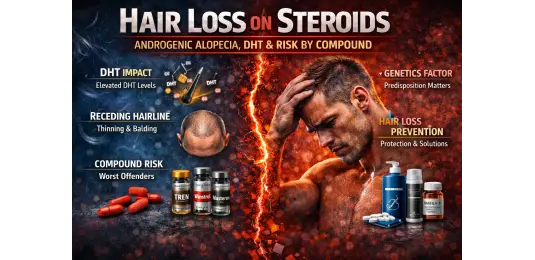
What Is Androgenic Alopecia and Why Steroids Accelerate It

Androgenic alopecia — male pattern hair loss — is not caused by steroids. It is caused by a genetic sensitivity of scalp hair follicles to dihydrotestosterone (DHT), a more potent androgen metabolised from testosterone by the 5-alpha reductase (5-AR) enzyme. Steroids accelerate a process already encoded in your genetics: if you carry the androgen receptor sensitivity variant associated with pattern baldness, exogenous androgens increase the rate and severity of follicle miniaturisation far beyond what endogenous testosterone alone would produce over the same timeline.

DHT binds to androgen receptors in susceptible scalp follicles — concentrated on the crown and hairline — and triggers progressive miniaturisation: each successive hair growth cycle produces a shorter, thinner, less pigmented hair until the follicle stops producing visible hair entirely. The follicle remains viable but the shrinkage is largely permanent once it crosses a threshold. Anabolic androgenic steroids increase the androgenic load on scalp follicles either directly or by producing DHT or DHT-like metabolites that bind scalp androgen receptors with high affinity.

This is categorically different from the acne mechanism — see Acne on Steroids for the overlapping DHT-driven skin effects — because androgenic alopecia damage occurs at the follicular level and is largely irreversible once miniaturisation has progressed.

The DHT Mechanism: 5-Alpha Reductase and Scalp Follicle Sensitivity

Not all androgens reach the scalp as DHT. The conversion pathway determines both the risk level and which protective strategies apply:

  • Testosterone-based compounds are converted to DHT by 5-alpha reductase Type II in scalp tissue. The higher the circulating testosterone and 5-AR activity, the more DHT accumulates at the follicle. This applies to all testosterone esters including Testabol Enanthate, Testabol Propionate, Sustabol 350, and Andropen 450. Critically, this pathway is addressable with Finasteride — a 5-AR inhibitor that reduces scalp DHT conversion by approximately 60–70%.
  • DHT-derived compounds are structurally resistant to further 5-AR conversion but bind scalp androgen receptors directly with high affinity. Stanabol 50 Tablets and Stanabol 50 Inj (Stanozolol), Mastabol 100 (Drostanolone Propionate), and Mesterolone Tablets all fall into this category. Finasteride provides no protection here — these compounds bypass the 5-AR pathway entirely.
  • 19-nor compounds — Nandrolone and Trenbolone — do not convert to DHT. Nandrolone (Decabol 250, Durabol 100) converts to dihydronandrolone, which carries significantly lower scalp androgenicity. Trenbolone compounds (Trenabol 100, Trenabol 200, Trenabol Hexa) do not convert to DHT but carry significant intrinsic androgenicity — they activate scalp androgen receptors directly. Trenbolone's hair loss risk is real and not addressable by Finasteride.
  • High-androgenic oral compoundsHalotestex Tablets (Fluoxymesterone, androgenic index ~1,900) pose severe androgenic alopecia risk in predisposed individuals. Oxydrol Tablets (Oxymetholone) carries moderate to high risk despite not converting to DHT. Turanabol Tablets carry moderate risk, reduced somewhat by its 4-chloro modification.

Compound Risk Hierarchy for Androgenic Alopecia

  • Highest risk: Halotestex Tablets — extreme androgenicity, no 5-AR pathway required; Trenbolone series (Trenabol 100, Trenabol 200, Trenabol Hexa) — high intrinsic androgenicity, Finasteride ineffective; Stanabol 50 Tablets and Stanabol 50 Inj at high dose — DHT-derived, Finasteride ineffective
  • High risk: Mesterolone Tablets — highest DHT receptor specificity of any oral compound; Mastabol 100 and Mastabol 200 — DHT-derived, not Finasteride-addressable; high-dose testosterone without 5-AR management; Oxydrol Tablets
  • Moderate risk: Methanabol and Methanabol 50 — aromatises, DHT-adjacent metabolites; Turanabol Tablets; Sustabol 350 — testosterone component is Finasteride-addressable
  • Lower risk: Primobol Inject (Methenolone — DHT-derived but very low scalp receptor affinity; widely considered the most hair-safe injectable anabolic); Oxanabol Tablets (Oxandrolone — among the most hair-safe orals); Boldabol 200 (Boldenone — low androgenicity, limited scalp conversion); Nandrolone compounds (Decabol 250, Durabol 100)

Your Genetics Determine the Outcome

The single most important factor in steroid-accelerated hair loss is whether the athlete carries the androgen receptor sensitivity variant (AR gene polymorphism on the X chromosome) associated with male pattern baldness. An athlete without genetic predisposition can run high-androgenic cycles with minimal scalp impact. An athlete with strong predisposition may experience significant hairline recession within weeks of a first cycle with even moderate compounds.

Predictive markers: family history — maternal grandfather's hairline pattern is the classic indicator (X-linked AR gene, maternally inherited); personal juvenile hairline stability; and most importantly, hairline response during a first testosterone cycle. Any existing recession before a first cycle confirms active predisposition already underway.

Managing Hair Loss on Cycle

  • Finasteride: Finasteride 1 mg/day blocks 5-AR Type II and reduces scalp DHT from testosterone-based compounds by ~60–70%. Effective specifically when the hair loss driver is testosterone-to-DHT conversion. Not effective for DHT-derived compounds or Trenbolone. Important caveat: systemic DHT suppression can impair libido and sexual function in sensitive individuals — calibrate carefully. Relevant context: Estrogen Control on Cycle for the broader hormonal balance picture during management protocols.
  • Minoxidil: Minoxidil (topical, 5% solution or foam, applied twice daily) extends the anagen growth phase and improves follicular blood supply. It does not address the androgenic mechanism directly but partially counteracts miniaturisation by supporting follicle function. Most effective as an adjunct to Finasteride; less effective as a sole intervention in a high-androgen environment. Systemic absorption at standard topical doses is minimal.
  • Compound selection: The most effective hair-protective strategy for predisposed athletes. Replacing high-DHT compounds with lower-risk alternatives where cycle goals permit — Primobol Inject instead of Stanabol 50 Tablets for a hardening agent, Oxanabol Tablets instead of higher-androgenic orals — produces better long-term outcomes than pharmacological management of an inherently high-risk selection.
  • Ketoconazole shampoo (2%): Mild anti-androgenic activity at the scalp. Used 2–3 times per week as an inexpensive adjunct. Not a primary intervention but reduces local scalp DHT activity marginally when used consistently.

Can Hair Grow Back After a Cycle?

Partial recovery is possible in early-stage miniaturisation — follicles that have thinned but not permanently atrophied may partially recover over 3–6 months as DHT normalises after the cycle ends. The PCT protocol contributes here: the recovery period temporarily reduces total androgenic exposure, creating a window for partial follicular recovery.

In advanced miniaturisation — where the follicle has lost its dermal papilla vascularity and can no longer produce terminal hair — the loss is permanent regardless of hormonal normalisation. Protecting existing follicles proactively is fundamentally more effective than attempting recovery after the fact.

Conclusion

Androgenic alopecia from steroid use is not inevitable — but it is unmanageable without understanding the mechanism, the compound risk hierarchy, and your individual genetic predisposition. For genetically susceptible athletes, compound selection is the primary protective lever: Primobol Inject and Oxanabol Tablets for lower-risk cycles; Finasteride and Minoxidil as the pharmacological support layer on testosterone-based protocols. The hair that has not yet been lost is far easier to protect than the hair that is already gone.

FAQ

Q1. Which steroids cause the most hair loss? The highest risk compounds are those that either convert aggressively to DHT via 5-alpha reductase (high-dose testosterone from Testabol Propionate, Testabol Enanthate, Sustabol 350), are DHT derivatives acting directly at scalp receptors (Stanozolol in Stanabol 50 Tablets and Stanabol 50 Inj; Drostanolone in Mastabol 100 and Mastabol 200; Mesterolone Tablets), or carry extreme intrinsic androgenicity (Halotestex Tablets at androgenic index ~1,900; Trenbolone compounds). The lowest risk compounds include Primobol Inject (Methenolone), Oxanabol Tablets (Oxandrolone), Decabol 250, and Durabol 100 (Nandrolone) — all with low scalp androgen receptor activity relative to their anabolic output.
Q2. Will Finasteride protect my hair on a steroid cycle? Finasteride works by blocking 5-alpha reductase Type II, reducing testosterone-to-DHT conversion at the scalp by approximately 60–70%. It is effective protection specifically when the primary hair loss driver is a testosterone-based compound — Testabol Enanthate, Testabol Propionate, Sustabol 350, Andropen 450. It provides no protection against DHT-derived compounds like Stanozolol, Drostanolone, or Mesterolone, which bypass the 5-AR pathway entirely. It also does not address Trenbolone's direct scalp androgenicity. For cycles centred on DHT-derived or high-androgenic non-5-AR compounds, compound selection and topical Minoxidil are the relevant strategies — Finasteride adds no meaningful benefit.
Q3. Does hair lost from steroids grow back after the cycle ends? It depends on how far miniaturisation progressed. Early-stage miniaturisation — thinning but not permanently atrophied follicles — may partially reverse over 3–6 months post-cycle as DHT normalises. The hormonal recovery period during PCT can support this window. Advanced miniaturisation — where the follicle has permanently lost its productive capacity — does not recover regardless of hormonal normalisation. This is the accumulative permanent loss that builds across multiple high-androgenic cycles in predisposed individuals. Proactive protection during the cycle is always more effective than attempting recovery afterward.
Q4. How do I know if I am genetically at risk before starting a cycle? Three reliable indicators: first, examine your own hairline — any existing recession or crown thinning before a first cycle confirms active androgenetic alopecia already in progress. Second, assess your maternal grandfather's hairline (the X-linked AR polymorphism is maternally inherited; this is a stronger predictor than your father's pattern alone, though both contribute). Third, monitor hairline response carefully in the first 4 weeks of a first testosterone cycle — rapid or pronounced hairline change at moderate dose confirms high genetic predisposition. Commercial genetic testing for AR gene polymorphism is available and provides definitive confirmation before committing to a high-androgenic protocol.
Q5. Can I still run high-androgenic compounds if I am prone to hair loss? Yes — but the approach must be deliberate. Where goals allow, substitute lower-risk alternatives: Primobol Inject instead of Stanabol for a hardening agent, Oxanabol Tablets instead of higher-androgenic orals, Decabol 250 as a secondary compound instead of a testosterone-only mass base. When high-androgenic compounds are genuinely necessary — Trenbolone for advanced pre-contest preparation, for example — understand that Trenbolone's scalp impact is not addressable by Finasteride; the trade-off must be consciously accepted. Use topical Minoxidil consistently throughout all high-androgenic cycles. Keep cycle durations within the shortest effective window — cumulative androgenic exposure across multiple cycles determines total lifetime follicle loss in predisposed athletes.