High Estrogen Symptoms on Steroids and TRT: What Elevated E2 Really Feels Like
  • By Ethan Cole
  • June 1, 2026
  • Reading Time: 18 mins
High Estrogen Symptoms on Steroids and TRT: What Elevated E2 Really Feels Like
Hormone Bloodwork Guide

High Estrogen Symptoms on Steroids and TRT: What Elevated E2 Really Feels Like

High estrogen symptoms on steroids are among the most searched hormone-related topics in bodybuilding and TRT communities. The problem is that much of the information available online is either overly simplistic or completely disconnected from how hormone physiology actually works.

Many athletes learn to fear estrogen long before they understand it. They hear that estradiol causes water retention, gynecomastia, mood swings, and blood pressure problems. Eventually every symptom becomes estrogen. If bodyweight increases, estrogen gets blamed. If libido changes, estrogen gets blamed. If a blood test shows a higher E2 value than expected, estrogen becomes the enemy.

Real physiology is rarely that simple.

Estradiol is not merely a side effect of testosterone. It is an important hormone that contributes to libido, erectile function, cardiovascular health, recovery, mood regulation, bone health, and overall well-being. Men need estrogen. The question is not whether estradiol should exist. The question is whether hormone balance remains appropriate for the individual.

High estrogen symptoms on steroids can occur when estradiol rises beyond what a person comfortably tolerates. At that point symptoms may begin to appear. Water retention can increase. Blood pressure may move upward. Nipple sensitivity may develop. Mood and libido may change. Yet even then, symptoms should never be interpreted without context.

Understanding high estrogen symptoms on steroids requires looking beyond one laboratory result. Testosterone, free testosterone, SHBG, blood pressure, body composition, cardiovascular health, and symptom patterns all contribute to the larger picture.

This article explains what elevated estradiol actually means, why it occurs during TRT and anabolic steroid use, how symptoms develop, why many men misinterpret them, and why chasing a perfect estradiol number often creates larger problems than it solves.

Quick Summary

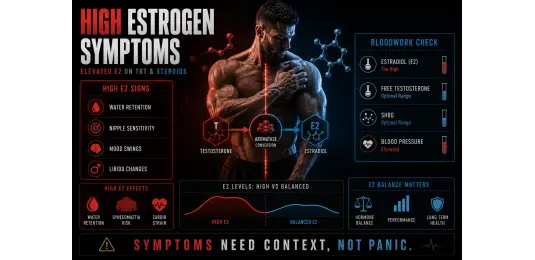
  • High estrogen symptoms on steroids may include water retention, nipple sensitivity, blood pressure changes, mood fluctuations, and libido changes.
  • Estradiol is a necessary male hormone and should not automatically be viewed as harmful.
  • Higher testosterone exposure generally increases aromatization and estradiol production.
  • Symptoms matter more than a laboratory value by itself.
  • Many men confuse high estrogen symptoms on steroids with low estrogen symptoms.
  • Aggressive estrogen suppression often creates unnecessary problems.
  • The goal is hormonal balance rather than eliminating estradiol.

What High Estrogen Means in Men

High estrogen symptoms on steroids are usually associated with elevated estradiol, often abbreviated as E2. Estradiol is produced when testosterone converts through the aromatase enzyme. This conversion process, called aromatization, occurs naturally in healthy men every day.

The presence of estradiol is not evidence of a problem. The body intentionally creates estradiol because it serves multiple physiological functions. Without adequate estradiol, sexual function, mood, joint comfort, recovery, and cardiovascular health can all suffer.

Problems may develop when estradiol rises enough to create symptoms or when the balance between testosterone and estradiol becomes less favorable for the individual.

This distinction is important because elevated estradiol on bloodwork does not automatically mean a man is experiencing high estrogen symptoms on steroids. Some individuals tolerate relatively high estradiol levels without obvious issues. Others become symptomatic at lower levels.

This is one reason experienced clinicians focus on symptoms, trends, and overall health markers instead of reacting to a single laboratory result.

Why Estradiol Rises on TRT and Steroids

The most common reason high estrogen symptoms on steroids develop is straightforward: testosterone increases.

Because estradiol is largely produced from testosterone, greater testosterone exposure creates greater opportunity for aromatization. When testosterone rises, estradiol often rises as well.

This relationship explains why estradiol frequently increases during TRT and anabolic steroid use.

Several variables influence how much estradiol a man produces:

  • Total testosterone exposure
  • Body fat percentage
  • Genetics
  • Aromatase activity
  • Insulin sensitivity
  • Age
  • Metabolic health
  • Lifestyle habits

Body fat deserves particular attention because adipose tissue contains aromatase activity. Individuals carrying more body fat often convert more testosterone into estradiol than leaner individuals.

This helps explain why two men using similar protocols may show completely different estradiol results and symptom profiles.

High estrogen symptoms on steroids therefore depend on much more than dosage alone.

Why Testosterone Dose Is Not the Whole Story

Many users assume higher testosterone automatically means more estrogen and therefore more high estrogen symptoms on steroids.

While testosterone exposure certainly influences estradiol production, the relationship is not perfectly predictable.

Body fat levels, genetics, aromatase activity, insulin sensitivity, metabolic health, age, and lifestyle all affect how much testosterone converts into estradiol.

This explains why two men using similar testosterone doses may experience completely different estradiol levels and symptom profiles.

One individual may report excellent libido, stable mood, and minimal water retention. Another may experience significant high estrogen symptoms on steroids despite following a nearly identical protocol.

The difference is not always the dose itself. Individual response matters.

This is another reason modern hormone management focuses on monitoring, bloodwork, symptoms, and long-term trends rather than relying exclusively on dosage calculations.

Why Elevated Estradiol Is Not Automatically a Problem

One of the biggest mistakes in hormone management is assuming every increase in estradiol requires immediate action.

High estrogen symptoms on steroids are symptom-based, not number-based.

A man may show elevated estradiol on bloodwork while simultaneously reporting strong libido, healthy erections, stable mood, good recovery, normal blood pressure, and no nipple sensitivity.

In this situation, a laboratory value alone may not justify aggressive intervention.

Many hormone-related problems begin when users become obsessed with numbers and stop paying attention to how they actually feel.

Bloodwork is an important tool, but it should support symptom interpretation rather than replace it.

High estrogen symptoms on steroids become much easier to understand when laboratory results are viewed as one piece of a larger picture rather than the entire picture.

Why Many Men Fear Estrogen Too Much

The bodybuilding world has spent decades treating estrogen as the primary villain behind every unwanted side effect.

While estrogen-related issues certainly exist, this mindset often pushes athletes toward unnecessary intervention.

High estrogen symptoms on steroids receive far more attention than low estrogen symptoms. As a result, many users learn how to fear estradiol long before they learn how estradiol actually works.

This creates a common pattern. A user sees a slightly elevated estradiol result, becomes concerned, immediately focuses on lowering E2, and eventually develops low-estrogen symptoms that feel worse than the original situation.

Experienced athletes eventually discover that hormonal balance is far more important than aggressively chasing low estradiol levels.

High Estrogen vs Low Estrogen

One reason high estrogen symptoms on steroids create confusion is that low estrogen symptoms can sometimes appear surprisingly similar.

High Estradiol Low Estradiol
Water retention Dry joints
Nipple sensitivity Low libido
Possible blood pressure increases Poor erections
Puffier appearance Flat mood
Emotional volatility Reduced recovery
Gynecomastia risk Joint discomfort

This comparison does not replace bloodwork, but it highlights why symptoms should never be interpreted through assumptions alone.

High Estrogen and Water Retention

Water retention is one of the most recognizable high estrogen symptoms on steroids. It is also one of the most misunderstood.

Many athletes assume any sudden increase in bodyweight automatically means fat gain. In reality, fluid balance can change significantly when hormone levels shift.

Estradiol influences several physiological systems involved in fluid regulation. When estradiol rises, some individuals retain noticeably more water. Others experience very little change.

Common signs include:

  • Puffier facial appearance
  • Less visible muscular definition
  • Rapid bodyweight fluctuations
  • Tighter clothing or rings
  • A softer overall physique appearance

Bodybuilders often notice these changes quickly because they spend years monitoring physique details. What appears insignificant to the average person may become obvious to someone preparing for a competition, photoshoot, or physique assessment.

High estrogen symptoms on steroids become particularly noticeable when water retention affects both appearance and comfort.

However, water retention alone does not automatically indicate a dangerous situation. Blood pressure, cardiovascular markers, recovery, and overall health should always be considered.

Why Water Retention Does Not Always Mean High Estrogen

One of the most common mistakes made by athletes is assuming water retention automatically means high estrogen symptoms on steroids are present.

While estradiol can certainly contribute to fluid retention, it is not the only factor involved.

Sodium intake, carbohydrate intake, sleep quality, stress levels, cortisol, hydration status, blood pressure, and overall hormone balance can all influence how much water a person retains.

This is particularly important during TRT and steroid use because many compounds influence bodyweight and fluid distribution independently of estradiol.

An athlete may increase carbohydrate intake, experience a rapid increase in glycogen storage, and suddenly notice several pounds of additional scale weight. The assumption may be that estrogen is rising when the explanation is actually nutritional.

High estrogen symptoms on steroids should therefore never be diagnosed from appearance alone.

Bloodwork, blood pressure, symptom patterns, and the broader health picture provide far more useful information than a temporary increase in bodyweight.

This is one reason experienced coaches rarely make hormone decisions based solely on water retention.

Related reading:

Water Retention on Steroids

High Estrogen and Gynecomastia

Gynecomastia is one of the most feared high estrogen symptoms on steroids.

The term refers to the development of glandular breast tissue in males. Hormonal imbalance can contribute to this process, particularly when estrogenic activity increases relative to androgenic influence.

Early warning signs may include:

  • Nipple sensitivity
  • Nipple irritation
  • Tenderness around the nipple area
  • Changes in tissue texture beneath the nipple
  • Persistent discomfort

One important point is that nipple sensitivity does not automatically mean gynecomastia is developing. Many users experience temporary sensitivity without progressive tissue changes.

This is another example of why high estrogen symptoms on steroids should be evaluated through trends rather than panic.

Bloodwork, symptom progression, physical changes, and overall hormonal context all matter.

High Estrogen and Blood Pressure

Blood pressure receives far less attention than it deserves during discussions about high estrogen symptoms on steroids.

Many users focus exclusively on cosmetic concerns such as water retention or appearance changes while ignoring cardiovascular markers.

In certain individuals, elevated estradiol combined with fluid retention may contribute to increased blood pressure readings.

This does not happen universally, but it highlights why hormone management should never focus solely on aesthetics.

Long-term health requires monitoring blood pressure, lipids, hematocrit, cardiovascular markers, and hormone values together.

High estrogen symptoms on steroids should therefore be evaluated from both a performance perspective and a health perspective.

A physique may look impressive while important health markers trend in the wrong direction.

High Estrogen and Libido

Libido becomes particularly interesting when discussing high estrogen symptoms on steroids because many people expect a simple cause-and-effect relationship.

In reality, sexual desire depends on multiple factors working together.

Testosterone, estradiol, free testosterone, SHBG, psychological health, sleep quality, cardiovascular function, recovery, and overall well-being all contribute.

Some men maintain excellent libido despite elevated estradiol. Others notice reduced sexual desire when estradiol rises beyond what feels comfortable for their hormonal environment.

This variability explains why hormone management cannot be reduced to internet anecdotes.

High estrogen symptoms on steroids may affect libido, but the relationship is highly individual.

The key lesson is that symptoms should be interpreted alongside bloodwork rather than assumptions.

Why High Estrogen and Prolactin Get Confused

Another reason high estrogen symptoms on steroids create confusion is that several symptoms overlap with elevated prolactin.

Libido changes, erectile issues, nipple sensitivity, and reduced sexual function are frequently blamed on estradiol even when additional hormones may be involved.

This does not mean prolactin is always responsible. It simply highlights the danger of trying to diagnose hormone issues without proper bloodwork.

Many users assume they know the cause of a symptom before testing. Unfortunately, hormone physiology is rarely that simple.

Estradiol, prolactin, testosterone, free testosterone, SHBG, sleep quality, cardiovascular health, and stress can all influence sexual function.

High estrogen symptoms on steroids become much easier to understand when bloodwork confirms what is actually happening rather than relying on assumptions from internet discussions.

The goal is identifying the correct cause rather than treating the wrong hormone.

High Estrogen and Erectile Function

Erectile quality is another area where high estrogen symptoms on steroids often create confusion.

Many users assume every erection issue must be caused by testosterone. Others assume every erection issue must be caused by estrogen. Both explanations are usually too simplistic.

High estradiol may contribute to erectile difficulties in some individuals, particularly when hormonal balance becomes significantly disrupted.

However, erectile function also depends on cardiovascular health, blood pressure, sleep quality, stress levels, free testosterone, SHBG, and psychological factors.

This is why hormone interpretation should always include multiple markers rather than focusing on a single laboratory value.

High estrogen symptoms on steroids become easier to understand when viewed as part of a larger physiological system.

High Estrogen and Mood

Mood changes are among the most subjective high estrogen symptoms on steroids.

Some individuals report increased emotional sensitivity, irritability, mood fluctuations, or reduced emotional stability when estradiol rises significantly.

Others report very little change.

The challenge is that mood is influenced by many factors beyond hormones.

Sleep quality, stress, relationships, nutrition, recovery, workload, and general health can all influence emotional state.

For this reason, hormone interpretation should avoid simplistic conclusions.

High estrogen symptoms on steroids may contribute to mood changes, but they rarely act alone.

Symptoms That Deserve Attention

  • Persistent water retention
  • Nipple sensitivity that continues worsening
  • Unexpected blood pressure increases
  • Significant mood changes
  • Reduced libido
  • Changes in erectile quality
  • Progressive tissue changes around the nipple area
  • Symptoms that continue despite protocol stability

Why High Estradiol Can Look Different Between Individuals

One of the biggest mistakes in hormone discussions is assuming every man experiences high estrogen symptoms on steroids the same way.

Hormonal response varies dramatically between individuals.

Two men may show nearly identical estradiol results while reporting completely different symptom profiles. One may feel excellent, while the other experiences significant water retention, mood changes, libido issues, or blood pressure concerns.

Genetics, body composition, androgen levels, cardiovascular health, SHBG, lifestyle habits, sleep quality, stress levels, and training demands all influence how estradiol is experienced.

This is one reason experienced clinicians focus on patterns rather than arbitrary target numbers.

Hormone management is rarely about finding a universal number. It is about understanding how a particular individual responds.

High estrogen symptoms on steroids should therefore be interpreted through personal response rather than comparison with other users.

Why Symptoms Matter More Than One Number

High estrogen symptoms on steroids should never be judged from a single estradiol number alone.

Bloodwork matters, but hormone interpretation becomes much stronger when laboratory results are combined with symptoms, timing, and the broader health picture.

A man may show elevated estradiol and feel excellent. Another may show a similar result and feel noticeably worse. This difference does not mean the lab result is useless. It means the result needs context.

Important context includes:

  • Total testosterone
  • Free testosterone
  • SHBG
  • Blood pressure
  • Body composition
  • Water retention
  • Libido
  • Erectile quality
  • Mood
  • Recovery

High estrogen symptoms on steroids should be interpreted as a pattern rather than a single event.

When symptoms, bloodwork, and health markers all point in the same direction, interpretation becomes much stronger.

Bloodwork Markers to Check

High estrogen symptoms on steroids should be evaluated with more than estradiol alone.

Estradiol is important, but it does not explain everything by itself.

A more useful bloodwork review usually includes:

  • Estradiol
  • Total Testosterone
  • Free Testosterone
  • SHBG
  • Albumin
  • CBC
  • Hematocrit
  • Lipid Panel
  • Blood Pressure
  • Liver Markers

This broader approach prevents one of the most common mistakes in hormone management: reacting to one number while ignoring the rest of the system.

High estrogen symptoms on steroids often appear alongside other changes, especially water retention, blood pressure movement, or libido changes. Those patterns are easier to understand when the full panel is reviewed.

Why Bloodwork Timing Can Change Estradiol Results

One issue rarely discussed in online conversations is how testing timing can influence estradiol results.

Hormones fluctuate throughout a protocol. Depending on injection frequency, compound selection, and testing schedule, estradiol values may differ considerably.

This is one reason high estrogen symptoms on steroids should never be interpreted from a single isolated laboratory result.

Comparing bloodwork performed under inconsistent conditions can create confusion.

Many experienced TRT patients eventually learn that trend analysis is more valuable than focusing on one number.

Consistent testing conditions make it easier to identify whether estradiol is truly changing or whether differences simply reflect timing variation.

When evaluating high estrogen symptoms on steroids, context remains essential.

A laboratory value should never be viewed independently from injection timing, protocol structure, symptoms, and previous results.

Products Commonly Discussed in Estrogen Management

Several compounds are commonly discussed when users talk about high estrogen symptoms on steroids, estrogen control, or gynecomastia management.

These products should not be viewed as automatic solutions. They are hormone-related tools that require careful interpretation, bloodwork context, and awareness of the risks associated with excessive estrogen suppression.

Common Mistakes When Interpreting High Estrogen Symptoms

Assuming Every Symptom Is Estrogen

Not every symptom on TRT or a steroid cycle is caused by estradiol. Sleep quality, stress, blood pressure, training load, cardiovascular health, prolactin, thyroid status, and other hormones can all contribute.

High estrogen symptoms on steroids should be considered when the pattern fits, but estradiol should not become the automatic explanation for every problem.

Ignoring Low Estrogen Risk

Many users try to lower estrogen aggressively and then develop low estradiol symptoms. This is one of the most common mistakes in estrogen management.

Dry joints, poor erections, flat mood, reduced recovery, and low libido may appear when estradiol is pushed too low.

Reacting to One Blood Test

One lab result is useful, but trends are stronger. Testing conditions, injection timing, recent protocol changes, and symptoms all affect interpretation.

Using Aromatase Inhibitors Too Aggressively

Aromatase inhibitors can lower estradiol significantly. Using them without understanding bloodwork can lead to crashed E2 and worse symptoms.

Ignoring Blood Pressure

High estrogen symptoms on steroids often get discussed only in cosmetic terms, but blood pressure is one of the health markers that deserves serious attention.

Why Chasing a Perfect Estradiol Number Usually Fails

Many users want one ideal estradiol number that works for everyone.

Real physiology does not behave that way.

Two men can have the same estradiol value and feel completely different because their testosterone, free testosterone, SHBG, body fat, cardiovascular health, stress levels, and recovery capacity are different.

This is why chasing a perfect number often creates frustration.

High estrogen symptoms on steroids are better understood through trends, symptoms, and full-panel interpretation rather than one isolated value.

The goal is not making estradiol as low as possible. The goal is maintaining a hormone environment that supports sexual function, performance, recovery, mood, and health.

Practical Takeaway

High estrogen symptoms on steroids can be real, but they should not be interpreted through fear.

Estradiol is an important male hormone. It supports libido, erectile function, mood, cardiovascular health, recovery, and overall well-being.

Problems may appear when estradiol rises beyond what an individual tolerates well, especially when symptoms such as water retention, nipple sensitivity, mood changes, libido issues, or blood pressure increases appear together.

The smartest approach is not to panic and crush estrogen. The smarter approach is to review bloodwork, symptoms, timing, and the broader health picture.

Good hormone management is calm, consistent, and evidence-informed. It does not chase numbers blindly, and it does not ignore symptoms either.

Frequently Asked Questions

Q: What are high estrogen symptoms on steroids?

High estrogen symptoms on steroids may include water retention, nipple sensitivity, mood changes, libido changes, erectile issues, and blood pressure increases.

Q: How do I know if high estrogen symptoms on steroids are actually caused by estradiol?

Symptoms alone are not enough. Estradiol should be checked with bloodwork and interpreted alongside testosterone, free testosterone, SHBG, blood pressure, body composition, and symptom timing.

Q: Can high estrogen cause water retention?

Yes. Elevated estradiol may contribute to water retention in some individuals, but sodium intake, carbohydrate intake, stress, sleep, and blood pressure can also affect fluid balance.

Q: Can high estrogen cause erectile dysfunction?

High estradiol may contribute to erectile difficulties in some men, but cardiovascular health, sleep, stress, testosterone, free testosterone, and SHBG should also be reviewed.

Q: Can high estrogen cause gynecomastia?

Elevated estrogenic activity may contribute to gynecomastia risk, especially when nipple sensitivity or tissue changes progress over time.

Q: Should high estrogen always be lowered?

No. Estradiol should be interpreted with symptoms and bloodwork. Some men tolerate elevated estradiol well, and aggressive lowering can cause low E2 symptoms.