Testosterone Undecanoate vs Enanthate for TRT: What Actually Works Better
Introduction
Choosing the right testosterone for TRT is not just a technical detail but a decision that directly affects stability, mood, recovery, and long-term consistency. While many assume all testosterone behaves the same, the ester determines how hormone levels rise, stabilize, and fluctuate over time. In practice, the difference between enanthate and undecanoate becomes noticeable in how stable you feel week to week, not just what your bloodwork shows.
TRT is built around maintaining a consistent baseline rather than chasing peaks. This is why understanding ester behavior matters more than simply choosing a product. When the release pattern aligns with your routine, TRT feels smooth and predictable. When it does not, even correct dosing can feel unstable. For a broader context on when TRT becomes necessary, see natural testosterone vs TRT.
What Makes TRT Different From Cycles
TRT is not designed for rapid muscle gain or aggressive recomposition. Its role is to maintain stable hormone levels when natural production is insufficient. Unlike performance protocols, TRT prioritizes consistency, minimizing fluctuations that affect energy, mood, and recovery.
This is why most TRT setups rely on compounds from the Testosterone Base category, where the goal is long-term hormonal stability rather than short-term output. The difference is not the compound itself, but how it is used and managed over time.
Testosterone Enanthate on TRT
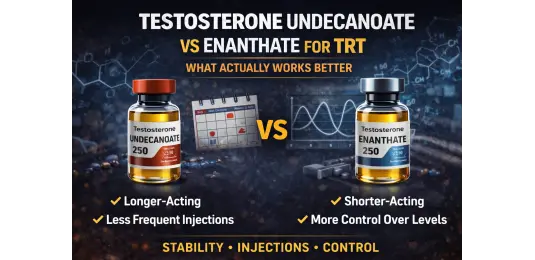
Testosterone enanthate is widely used in TRT because it offers a balance between control and stability. With a moderate release speed, it allows users to maintain consistent levels when injected one to two times per week. This makes it easier to adjust dosing based on bloodwork, symptoms, and overall response.
The main advantage of enanthate is flexibility. If something feels off, changes can be implemented relatively quickly, making it easier to fine-tune a protocol. However, this also means that stability depends heavily on consistent injection timing. Irregular dosing can lead to noticeable fluctuations in energy, mood, and libido.
Testosterone Undecanoate on TRT
Undecanoate 250 takes a different approach by prioritizing long-term stability over flexibility. As a long ester, it releases slowly and maintains more even hormone levels across extended periods. This reduces the need for frequent injections and minimizes the peaks and drops associated with shorter esters.
In real-world use, undecanoate is often preferred by users who want a consistent baseline without having to manage weekly fluctuations. The trade-off is slower adjustment speed. If dosing needs to be changed, the effect takes longer to show, making it less responsive compared to enanthate.
Injection Frequency and Stability
Injection frequency plays a major role in how stable TRT feels. Enanthate typically requires regular injections to avoid fluctuations, while undecanoate allows for longer intervals between administrations. This difference affects not only convenience but also how stable hormone levels remain throughout the week.
Users who prefer active control often lean toward enanthate, while those who want a more passive and stable setup tend to prefer undecanoate. Both approaches can work effectively when matched to the user's routine and expectations.
Blood Levels and Hormone Fluctuation
Hormonal fluctuation is one of the most important factors in TRT quality. Even when total testosterone is within range, large swings can negatively affect how you feel. Enanthate can produce mild peaks and drops if injection frequency is not optimized, which may influence mood, energy, and training consistency.
Undecanoate minimizes these fluctuations by maintaining a smoother release curve. This often results in a more stable day-to-day experience, which is especially important for long-term adherence. Managing these fluctuations is closely connected to broader topics like estrogen control and water balance, which affect how stable the cycle feels overall.
Support and Health Management
Even at TRT levels, testosterone affects multiple systems, including cardiovascular health, lipid profile, and hormonal balance. This is why structured support becomes part of long-term TRT rather than an optional addition. Stability in hormone levels makes support easier to apply consistently rather than reactively.
Users often rely on support strategies from categories like Heart & Vascular and Anti-Aging, where long-term health and hormonal balance are addressed together. It is also important to understand that protocol quality and sourcing can impact outcomes, as discussed in cheap TRT risks and safety. In cases where estrogen rises beyond a comfortable range, compounds like Arimidex may be used carefully to maintain balance rather than suppress it completely.
Which One Is Better for Different Users
The choice between enanthate and undecanoate depends on how much control versus stability a user prefers. Enanthate is better suited for those who want to actively manage their protocol, adjust doses quickly, and respond to changes based on feedback or bloodwork.
Undecanoate is more suitable for users who prioritize consistency and simplicity. It reduces the need for frequent injections and minimizes fluctuations, making it easier to maintain a stable routine over time without constant adjustments.
Real-World Take
In practice, both esters can work extremely well when used correctly. The difference is not effectiveness but experience. Enanthate provides more control but requires discipline, while undecanoate simplifies the process and reduces variability at the cost of slower adjustments.
Long-term TRT success depends less on the ester itself and more on consistency, monitoring, and how well the protocol fits the user's lifestyle. When these factors align, both options can deliver stable and predictable results.
Conclusion
Testosterone enanthate and undecanoate represent two different approaches to TRT. One focuses on flexibility and control, while the other emphasizes stability and convenience. Neither is inherently superior, but each fits a different type of user and routine.
The best choice is the one that allows you to maintain stable hormone levels with minimal disruption to your routine. When TRT is structured correctly, it becomes a consistent foundation for performance, recovery, and overall well-being.
FAQ
Is testosterone undecanoate better than enanthate for TRT?
Undecanoate provides more stable levels, while enanthate offers better control and faster adjustments.
Which ester has less fluctuation?
Undecanoate generally produces fewer fluctuations due to its long release profile.
How often should enanthate be injected?
Typically one to two times per week to maintain stable levels.
Is undecanoate suitable for beginners?
Yes, especially for those who prefer fewer injections and a more stable routine.
Do both require health monitoring?
Yes, TRT always requires monitoring of estrogen, cardiovascular health, and overall hormone balance.