How to Increase Testosterone Naturally vs TRT: What Actually Works
  • By Dr. Zimer H.
  • April 10, 2026
  • Reading Time: 5 mins
How to Increase Testosterone Naturally vs TRT: What Actually Works
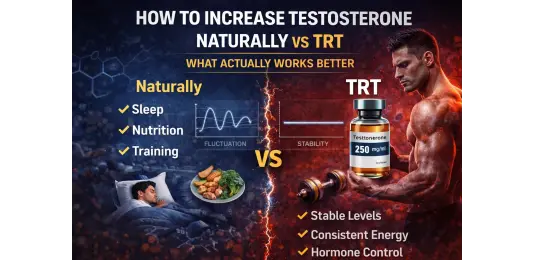
How to Increase Testosterone Naturally vs TRT: What Actually Works

Introduction

Low testosterone affects performance, recovery, and overall well-being. The problem is common, but the solution is often misunderstood.

Some people start with natural methods and expect major improvement. Others move straight to TRT without understanding where the real threshold lies. In practice, both approaches can work, but they operate on very different levels.

The key is not choosing blindly. The real question is where natural optimization stops helping and where TRT becomes necessary. Without that distinction, people either waste time chasing small improvements or jump into hormone replacement without understanding the long-term commitment.

Why Testosterone Drops

Testosterone levels can decline for several reasons:

  • Poor sleep quality
  • Chronic stress
  • Inadequate nutrition
  • Lack of resistance training
  • Age-related hormonal decline
  • Suppression from previous compound use

In more advanced cases, natural recovery does not fully return. Levels can stay consistently below optimal range.

This is why identifying the root cause matters more than simply trying to raise testosterone. Without correcting the real issue, any improvement is usually limited and often temporary.

Natural Ways to Increase Testosterone

Natural testosterone optimization focuses on improving the conditions that support hormone production.

The most effective factors usually include:

  • Consistent high-quality sleep
  • Adequate dietary fats
  • Structured resistance training
  • Better stress management
  • Stable recovery habits

When these variables improve, testosterone can improve too. This is most noticeable when low levels are linked to lifestyle rather than deeper physiological causes.

Still, the effect is usually moderate. Natural methods help the body function better within its own limits. They do not create a new hormonal baseline. That is why many expectations become unrealistic.

Why Testosterone Boosters Fall Short

Over-the-counter testosterone boosters are often marketed as an easy answer. In real use, their impact is usually small.

Most rely on weak mechanisms. They may help in cases of minor deficiency, but they do not significantly raise testosterone in a stable system. For a deeper breakdown, see testosterone boosters explained.

Because of that, many users eventually move beyond supplements. They either focus on real lifestyle optimization or shift toward structured hormone replacement when natural production is no longer enough.

Where Natural Methods Stop Working

There is a clear point where natural methods stop producing meaningful results.

If testosterone remains low despite proper sleep, solid nutrition, and structured training, the issue becomes more physiological than behavioral. At that stage, extra effort often gives very little return.

This is usually when people notice:

  • Persistent fatigue
  • Reduced recovery
  • Lower libido
  • Weaker day-to-day performance
  • Difficulty maintaining training quality

When these symptoms remain consistent, natural methods alone are usually not enough to restore balance.

TRT as a Solution

Testosterone Replacement Therapy works differently. Instead of trying to stimulate production, TRT provides a stable outside source of testosterone when natural production is insufficient.

This creates a more predictable environment for recovery, performance, and daily function.

Unlike natural methods, TRT does not depend on ideal conditions to work. It replaces what is missing and maintains it over time.

Cost and quality still matter. Poor protocol design or low-quality care can create more problems, as explained in cheap TRT risks and safety. The broader idea is also covered in TRT Explained.

Compound choice also changes the experience. Long-acting options such as Undecanoate 250 provide smoother release with fewer fluctuations, while other esters give faster control. This is explored further in Undecanoate vs Enanthate.

Natural vs TRT: The Real Difference

The difference between natural optimization and TRT is not just about results. It is about mechanism.

Natural methods improve production inside the body's existing limits. TRT replaces production and creates a new baseline that no longer depends on those same limits.

That leads to a very different experience:

  • Natural optimization: improves function inside your current range
  • TRT: establishes a stable level independent of fluctuating output

This is why the two approaches should not be treated as interchangeable.

Health and Support Considerations

Hormonal balance is closely tied to overall health, regardless of the method used.

TRT requires monitoring of cardiovascular health, lipid profile, and hormone balance over time. That is why users often explore support strategies through Heart & Vascular and Anti-Aging.

In some cases, estrogen also needs to be managed carefully. Compounds like Arimidex may be used when necessary, but the goal is balance rather than suppression. This connects directly to estrogen control.

Real-World Take

In practical use, natural methods should usually come first. But they should not be overestimated.

They work best when the problem is driven by lifestyle. They become limited when testosterone production is already compromised.

TRT is not a shortcut. It is a structured solution for restoring stability when natural optimization is no longer enough. The important part is recognizing when that transition becomes necessary.

Conclusion

Natural testosterone optimization and TRT serve different roles.

Natural methods improve existing production. TRT replaces production when it is no longer sufficient.

Once that distinction is clear, decision-making becomes much easier. Both approaches can be useful, but only when matched to the actual condition rather than expectation or marketing.

FAQ

Can you increase testosterone naturally?

Yes. Sleep, nutrition, training, and stress control can improve testosterone, but the effect is usually moderate.

Do testosterone boosters work?

They may help in cases of deficiency, but they do not significantly increase testosterone in most people.

When is TRT necessary?

TRT becomes relevant when testosterone stays low despite proper lifestyle habits and begins to affect recovery, function, and daily performance.

Is TRT better than natural methods?

It is more effective when natural production is insufficient, but it is not necessary when levels can still improve naturally.

Can you switch from natural methods to TRT?

Yes. Many users move to TRT when natural optimization no longer provides enough improvement.