Joint Pain on Steroids

  • By Dr. Miranda Bails
  • April 17, 2026
  • Reading Time: 9 mins
Joint Pain on Steroids
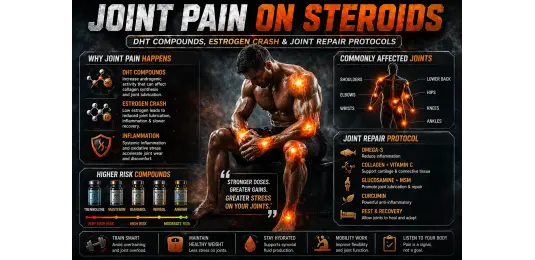
Why Steroids Cause Joint Pain: Two Distinct Mechanisms

The clinical presentation of joint pain on a steroid cycle is almost identical regardless of the cause — aching, crackling, reduced range of motion, and stiffness that is typically worst at the shoulder, elbow, and knee. The mechanisms producing that presentation, however, are pharmacologically opposite: one results from compounds that are DHT derivatives reducing synovial fluid production, and the other results from estrogen being suppressed too far by aromatase inhibitor over-dosing. The management of each is different enough that treating the wrong cause not only fails but can actively worsen the problem.

A third category — direct androgenic tissue stress — contributes at high doses and with compounds that increase connective tissue tension, but this is generally a secondary factor compared to the synovial fluid and estrogen mechanisms.

DHT Compounds and Synovial Fluid Depletion

Synovial fluid is the joint's internal lubricant — a viscous fluid produced by the synovial membrane that reduces friction between cartilage surfaces, provides joint nutrition, and acts as a shock absorber. Its production and viscosity are regulated partly by androgenic activity in the synovial membrane: the DHT receptor profile in synovial tissue responds to DHT exposure by reducing fluid secretion and altering fluid composition.

DHT-derived anabolic steroids — including Stanozolol, Drostanolone (Masteron), and Oxandrolone — bind synovial androgen receptors and progressively reduce synovial fluid volume during the cycle. The result is the characteristic "dry joint" presentation: joints that creak, ache under load, and lose comfortable range of motion within 2–4 weeks of starting the compound.

The dry-joint effect is most consistently reported with Stanabol 50 Tablets (Stanozolol), where it is dose-dependent and nearly universal in athletes using the compound for 4+ weeks. This is also relevant to the androgenic side effect profile of these DHT-derived compounds discussed at Hair Loss on Steroids — Stanozolol and Masteron drive both joint dryness and androgenic alopecia through their high-affinity DHT receptor binding, making them a poor choice for athletes with pre-existing joint vulnerabilities or genetic hair loss sensitivity.

Management for DHT compound-driven joint pain:

  • Glucosamine and chondroitin supplementation: Supports synovial membrane function and cartilage matrix maintenance — evidence base is modest but consistent for joint health support during high-DHT cycles
  • Dose reduction: The dry joint effect scales with DHT receptor exposure; reducing Stanozolol dose from 50 mg/day to 25–30 mg/day often produces significant improvement in joint comfort while preserving meaningful anabolic output
  • Compound substitution: For athletes where joint pain significantly impairs training, replacing the DHT-derived compound with a lower-androgenicity alternative is the most reliable long-term solution
  • Adding a low-dose Nandrolone: The joint-protective mechanism of Nandrolone (described below) directly counteracts the synovial depletion from DHT compounds when run concurrently

Estrogen, Collagen, and AI Over-Suppression

Estrogen has critical structural functions in connective tissue and joint health that are almost entirely absent from popular discussion in the performance community. Estrogen receptors are present throughout the synovial membrane, articular cartilage, and ligament tissue. Estrogen stimulates collagen synthesis, maintains synovial fluid viscosity, and supports the tensile strength of ligaments and tendons. When estradiol is suppressed below physiological range — the consequence of aromatase inhibitor over-dosing — these protective functions are impaired.

The clinical result is joint pain that is indistinguishable in feel from DHT-compound dry joint syndrome but has a completely different cause. Athletes on high-testosterone cycles who are aggressively using Anastrozole 1 mg or Exemestane Tablets at doses that drive estradiol below 15 pg/mL will typically experience worsening joint pain, ligament laxity, and increased injury susceptibility. This estrogen-deficiency joint presentation is covered in the broader context of estrogen management at Estrogen Control on Cycle.

The diagnostic question: Is the athlete running an aromatising compound (testosterone-based cycle) with an AI? If yes, and joint pain is present, bloodwork measuring estradiol is the correct first step — not adding a joint supplement or peptide. If estradiol is below 20 pg/mL, AI dose reduction is the intervention. Many athletes who report "joint pain from steroids" on testosterone-only cycles are experiencing AI over-suppression, not a compound-specific effect. The psychological effects of estrogen crash — depression, anhedonia — often accompany the joint pain, as described at Psychological Effects of Steroids.

Nandrolone: The Joint-Protective Compound

Nandrolone has an established reputation in performance pharmacology as the compound most associated with joint relief — frequently reported even at low doses (100–150 mg/week) as significantly improving joint comfort in athletes with existing wear. The mechanism operates through multiple pathways:

  • Nandrolone does not convert to DHT in the conventional sense — it converts to dihydronandrolone, which has very low affinity for the synovial androgen receptor — meaning it does not produce the dry-joint synovial depletion effect
  • Nandrolone's progestogenic activity includes anti-inflammatory effects in synovial tissue, directly reducing joint inflammation
  • Nandrolone promotes collagen synthesis in tendon and ligament tissue — anecdotally one of the strongest effects of any anabolic compound on connective tissue repair and resilience

For athletes with significant joint problems, Durabol 100 (Nandrolone Phenylpropionate) at 100–150 mg/week is frequently used as a joint-supportive addition to a cycle — providing meaningful joint protection without the full mass-building profile of higher-dose Nandrolone. The longer-acting Decabol 250 (Nandrolone Decanoate) provides the same joint-protective effects with less frequent injection demands for athletes where this is a priority rather than an ancillary consideration.

The HPTA suppression implications of adding Nandrolone — even at low joint-support doses — should not be overlooked. Nandrolone is among the most HPTA-suppressive compounds per milligram, as detailed at HPTA Suppression on Steroids. Low-dose Nandrolone for joint support still requires appropriate PCT planning regardless of dose.

Peptides for Joint Repair: BPC-157 and TB-500

Peptide therapies represent the most advanced targeted intervention available for connective tissue repair in performance pharmacology. Two peptides are specifically established for musculoskeletal and joint applications:

  • BPC-157 (Body Protective Compound-157) is a synthetic pentadecapeptide derived from a human gastric protein sequence. It demonstrates consistent upregulation of growth factor expression in tendon, ligament, and muscle tissue — accelerating repair of both acute injuries and chronic wear-related degradation. BPC-157 promotes angiogenesis in damaged tissue (new blood vessel formation, critical for repair oxygen delivery) and modulates nitric oxide signalling in connective tissue. Standard dosing: 250–500 mcg/day subcutaneously or intramuscularly, injected near the site of injury. Most athletes run a 4–8 week course for established joint issues.
  • TB-500 (Thymosin Beta-4) is a naturally occurring peptide with systemic anti-inflammatory and tissue repair activity. Where BPC-157 has more localised site-specific effects, TB-500 operates systemically — promoting actin regulation in damaged tissue, reducing inflammation across multiple sites simultaneously, and supporting satellite cell activation for muscle repair alongside connective tissue benefits. Standard dosing: 2–2.5 mg twice weekly for the first 4–6 weeks, then 2.5 mg once weekly for maintenance. TB-500 and BPC-157 are commonly combined — their complementary mechanisms (local BPC-157 repair plus systemic TB-500 anti-inflammation) produce stronger effects than either alone.

Pain Management: Meloxicam on Cycle

For athletes managing acute joint pain while continuing training, Mobic 7.5 mg (Meloxicam) is the most appropriate NSAID option in the performance context. Meloxicam is a preferential COX-2 inhibitor — its anti-inflammatory mechanism is more selective than non-specific NSAIDs like ibuprofen, producing equivalent analgesia with reduced gastrointestinal and cardiovascular side effect burden at standard doses. For more severe presentations, Mobic 15 mg provides the full therapeutic dose.

Important considerations for NSAID use during a performance cycle:

  • NSAIDs reduce prostaglandin synthesis — this has a modest but real effect on muscle protein synthesis pathways when used consistently. Intermittent use for pain management is preferable to daily continuous dosing where pain allows
  • NSAIDs in combination with anabolic steroids increase the risk of gastrointestinal stress — always use with food and limit duration to the shortest period needed for pain management
  • Meloxicam is not a structural intervention — it manages pain and inflammation but does not address the underlying synovial depletion or estrogen deficiency causing the joint problem. Peptide therapy and the compound-specific interventions above address root causes; Meloxicam manages the acute symptom while those interventions take effect

Conclusion

Joint pain on a steroid cycle is not one problem — it is at minimum two distinct problems with opposing management strategies. DHT-compound dry joints require synovial support, dose reduction, or adding low-dose Nandrolone from Durabol 100. Estrogen-deficiency joint pain requires AI dose reduction, confirmed by bloodwork. Where structural repair is needed, BPC-157 and TB-500 provide the most targeted intervention available. And Mobic 7.5 mg or Mobic 15 mg manages acute pain during the window while the underlying cause is addressed. Diagnosing the cause correctly — dry joint or estrogen crash — is the prerequisite for every step that follows.

Frequently Asked Questions

Why does Winstrol cause joint pain so consistently?

Stanozolol (Stanabol 50 Tablets, Stanabol 50 Inj) is a DHT-derived compound with high affinity for androgen receptors in the synovial membrane — the tissue responsible for producing synovial fluid. Sustained DHT receptor activation reduces synovial fluid secretion and alters fluid viscosity, progressively depleting joint lubrication. The effect is dose-dependent and nearly universal at doses above 30–40 mg/day for more than 2–3 weeks. Dose reduction to 25–30 mg/day often produces significant improvement while preserving meaningful anabolic output.

Can any steroids actually help joints rather than damage them?

Yes — Nandrolone is the most established joint-protective anabolic compound. It does not produce synovial depletion, actively promotes collagen synthesis in tendon and ligament tissue, and reduces synovial inflammation through progestogenic anti-inflammatory activity. Durabol 100 at 100–150 mg/week is commonly used specifically for joint support. Low-dose testosterone also provides mild joint support through its aromatisation to estradiol, which is essential for collagen synthesis and synovial membrane health.

Does BPC-157 actually work for steroid-related joint pain?

BPC-157 works on the structural repair side — promoting angiogenesis in damaged connective tissue, upregulating growth factor expression in tendons and ligaments, and supporting collagen matrix repair. It does not address the pharmacological cause of joint dryness or estrogen deficiency. The correct approach is to use BPC-157 and TB-500 for connective tissue repair while simultaneously addressing the root cause — reducing DHT compound dose, adding low-dose Nandrolone, or adjusting AI dosing to restore estradiol. BPC-157 at 250–500 mcg/day subcutaneously for 4–8 weeks is the standard protocol for joint and connective tissue applications.

Is it safe to take Meloxicam while on a steroid cycle?

Meloxicam (Mobic 7.5 mg or Mobic 15 mg) is the preferred NSAID option during a steroid cycle — its COX-2 selective mechanism produces effective analgesia with a better GI and cardiovascular profile than non-selective NSAIDs. Use intermittently rather than daily where possible, always with food. Meloxicam addresses pain and inflammation but does not fix the underlying cause — compound adjustment or AI dose correction remains the required intervention.

Will joint pain from steroids go away after the cycle ends?

DHT-compound dry joint pain typically resolves within 2–4 weeks of stopping the compound. Estrogen-deficiency joint pain resolves within 1–2 weeks of restoring estradiol to range. Structural connective tissue damage from training through joint pain recovers more slowly and may require 8–12 weeks of peptide therapy post-cycle. Treating joint pain when it first appears — rather than training through it — prevents cumulative structural damage that takes significantly longer to repair.