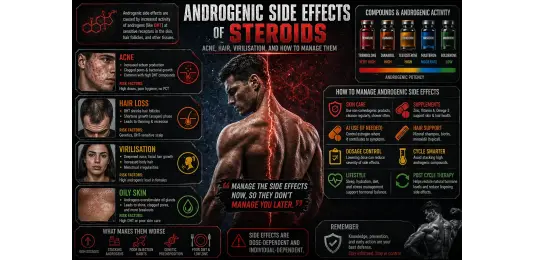
Androgenic Side Effects of Steroids
What "Androgenic" Means: The DHT Pathway
Anabolic steroids produce their effects through androgen receptor binding, but the specific receptor distribution and downstream enzymatic activity in different tissues determines whether the effect is anabolic (muscle growth, nitrogen retention) or androgenic (DHT-driven effects in skin, scalp, prostate, and other androgen-sensitive tissues). The distinction between anabolic and androgenic is not binary — it reflects the ratio of tissue-specific receptor activation relative to muscle.
The key enzyme is 5-alpha reductase (5-AR), which converts testosterone to dihydrotestosterone (DHT) in androgen-sensitive tissues — primarily skin, hair follicles, scalp, and prostate. DHT binds the androgen receptor with approximately 3–5× the affinity of testosterone, producing far more potent androgenic stimulation at these tissue sites. Compounds that are either already DHT derivatives (Stanozolol, Drostanolone, Oxandrolone) or that are readily converted to DHT by 5-AR (testosterone) carry proportionally higher androgenic side effect potential than compounds that resist or bypass this conversion pathway (Nandrolone, Boldenone, Methenolone).
Androgenic side effects are therefore compound-specific, dose-dependent, and genetically modulated — an athlete with high baseline 5-AR activity and a high density of androgen receptors in skin and follicular tissue will experience significantly more androgenic side effects from an identical cycle than an athlete with lower receptor sensitivity at those sites. Genetics determines the threshold; compound selection and dose determine whether that threshold is crossed.
Acne: The Most Common Androgenic Side Effect
Steroid-related acne is the single most consistently reported androgenic side effect across all user populations and compound profiles. The mechanism: DHT and anabolic androgens in general stimulate sebaceous gland proliferation and sebum secretion in the skin — the excess sebum, combined with the follicular keratinocyte changes that androgens produce, creates the environment for Propionibacterium acnes proliferation and the characteristic inflammatory acne presentation.
Location is diagnostically informative: steroid-related acne is predominantly truncal (chest, back, shoulders) rather than facial, reflecting the higher density of androgen- responsive sebaceous glands in these areas. Severe cases can develop into nodulocystic acne — large, deep, painful lesions that carry scarring risk and require active management rather than tolerating.
The full acne management approach — including the role of isotretinoin for severe cases, antibiotic regimens, and topical protocols — is covered at Acne on Steroids. From a compound selection standpoint: testosterone-based cycles produce moderate acne risk; DHT-derived compounds (Stanozolol, Drostanolone) produce higher risk; and compounds with minimal 5-AR activity (Nandrolone, Methenolone, Boldenone) produce the lowest acne risk among anabolic compounds.
Body Hair Growth (Hirsutism)
Androgenic stimulation of body hair follicles (as distinct from scalp hair follicles — which respond oppositely) produces accelerated growth of terminal body hair on the chest, back, arms, legs, and face. This reflects androgens' action on the vellus-to-terminal conversion pathway in body follicles: DHT stimulates follicular growth, deepens pigmentation, and increases growth rate in these sites.
Body hair growth on cycle is universal to some degree among male users of androgenic compounds — the severity scales with compound androgenic ratio and dose. It is not reversible by 5-AR inhibitors: 5-AR inhibition reduces DHT at scalp follicles (protective) but body hair follicles are also responsive to direct testosterone and other androgens. Reducing androgenic compound exposure is the only reliable prevention strategy. Post-cycle body hair typically stabilises — the increased follicle count from androgenic stimulation does not reverse, but the growth rate and thickness return toward baseline with hormonal normalisation.
For female users, body hair growth is one of the earliest and most sensitive virilisation indicators, appearing at doses well below those that produce other signs. It should prompt immediate dose reduction or cycle pause.
Scalp Hair Loss: The DHT-Follicle Relationship
The androgenic effect on scalp hair follicles is the inverse of the body hair effect: DHT receptor activation in genetically susceptible scalp follicles drives a progressive miniaturisation process — follicles producing thick terminal hairs transition to producing fine vellus hairs, then eventually cease productive growth altogether. This is androgenic alopecia, and steroid use in genetically predisposed athletes accelerates the same process that would occur more slowly with endogenous testosterone production alone.
The mechanism, the compounds most associated with accelerated loss, and the management options — including Finasteride and topical interventions — are covered in detail at Hair Loss on Steroids. The compound hierarchy for scalp hair loss risk mirrors the overall androgenic hierarchy: DHT-derived compounds (Stanozolol, Drostanolone, Oxandrolone) carry the highest per-milligram scalp risk; testosterone is moderate (reducible with 5-AR inhibitors); Nandrolone, Boldenone, and Methenolone carry the lowest risk.
Prostate Enlargement and Androgenic Stimulation
The prostate is one of the highest-density androgen receptor tissues in the male body. DHT is the primary androgen regulating prostatic growth and secretory function — approximately 90% of intraprostatic androgen activity is DHT-driven. Anabolic steroid cycles that increase circulating androgens — particularly DHT-converting testosterone cycles — produce proportional prostatic androgenic stimulation that can manifest as benign prostatic hyperplasia (BPH) symptoms over time: urinary urgency, frequency, reduced stream force, and incomplete emptying.
For athletes under 35 with no pre-existing prostate history, the clinical risk of meaningful BPH from performance-duration cycles is low — the prostate has significant physiological reserve before symptomatic hyperplasia develops. For athletes in their 40s and beyond, or those with familial prostate history, prostate monitoring becomes a relevant safety consideration. 5-AR inhibitors (see below) reduce intraprostatic DHT and provide meaningful prostate protection during testosterone-heavy cycles. Nandrolone and Methenolone, which have low DHT activity at the prostate, are associated with minimal prostatic androgenic stimulation.
Aggression and Mood: Androgenic CNS Effects
The androgenic component of steroid-related mood effects — the characteristic irritability and reduced frustration threshold often called "roid rage" — operates through androgen receptor activity in the amygdala and limbic system. High androgenic exposure, particularly from compounds with direct CNS androgen receptor affinity, increases the reactivity of stress-response circuits. This is mechanistically distinct from the cortisol and estrogen dysregulation contributing to anxiety and depression, and is covered in the full context at Psychological Effects of Steroids.
The practical relevance: Trenbolone, which has high androgenic CNS activity, consistently produces more irritability and aggression than testosterone or Nandrolone at comparable doses. DHT-derived compounds similarly produce more aggressive mood changes than non-DHT-converting alternatives. Athletes who experience significant mood changes on cycle should consider whether their compound androgenic profile — rather than the cycle itself as a whole — is the primary variable to adjust.
Notably, appropriate DHT levels contribute positively to mood, confidence, and sexual function — as covered at Libido and ED on Steroids. The androgenic effect on mood is not uniformly negative; excessive androgenic exposure relative to individual CNS sensitivity is the problem, not androgenic activity per se.
Virilisation in Female Users: The Most Critical Androgenic Risk
In female athletes, androgenic side effects carry an additional category of concern: irreversible virilisation. The female body expresses androgen receptors in identical tissues to males — sebaceous glands, hair follicles, vocal fold tissue, and clitoris — but with lower baseline androgenic exposure, making these tissues far more sensitive to exogenous androgen stimulation. Effects that require years to develop in males can appear within weeks in female users at performance doses.
The virilisation spectrum in order of typical onset:
- Acne: Often the first sign; appears within days to weeks of high-dose androgen use
- Body and facial hair growth: Accelerated within weeks; fully reversible at early stage if compound is stopped
- Clitoral enlargement (clitoromegaly): Weeks to months of moderate androgen exposure; partially to fully irreversible if androgen exposure continues beyond initial presentation
- Voice deepening: Progressive deepening of the vocal cords from androgenic stimulation of laryngeal tissue. This change is irreversible. Once the laryngeal tissues have undergone androgenic remodelling, no hormone intervention restores the original pitch. This single fact is the most important safety consideration for female steroid users.
- Male-pattern body hair distribution and scalp loss: At sustained high androgenic exposure; partially reversible after cessation
The female compound hierarchy for virilisation safety is clear and widely agreed: Primobol Inject (Methenolone Enanthate) is consistently the lowest-virilisation injectable anabolic compound available — Methenolone does not convert to DHT, has minimal 5-AR activity, and has the lowest androgenic rating among commonly used anabolic compounds. Female athletes using Methenolone at conservative doses (50–75 mg/week injectable) can achieve meaningful body composition changes with significantly lower virilisation risk than any testosterone-based compound. Oxandrolone is the second option, acceptable at low doses for limited periods.
Androgenic Ratings: Comparing Compounds
The androgenic:anabolic ratio assigned to each compound provides a reference framework for comparing androgenic side effect potential — the lower the androgenic number relative to the anabolic number, the greater the anabolic-to-androgenic selectivity. The reference compound is testosterone, which has an androgenic rating of 100 by convention:
- Methenolone (Primobolan/Primobol): Androgenic 44–57, Anabolic 88 — lowest androgenic activity among common injectables
- Boldenone (Equipoise): Androgenic 50, Anabolic 100 — moderate androgenic, suitable for DHT-sensitive athletes
- Nandrolone: Androgenic 37, Anabolic 125 — low DHT activity at key androgen tissues; favourable androgenic profile
- Testosterone: Androgenic 100, Anabolic 100 — reference compound; moderate androgenic risk reducible with 5-AR inhibitors
- Oxandrolone: Androgenic 24, Anabolic 322–630 — very low androgenic rating despite DHT-derived structure; but tissue-specific androgenic effects (scalp, prostate) persist
- Drostanolone (Masteron): Androgenic 130–300, Anabolic 62–130 — high androgenic per anabolic unit; significant scalp and skin androgenic activity
- Trenbolone: Androgenic 500, Anabolic 500 — extremely high androgenic rating; significant CNS and systemic androgenic effects at all performance doses
- Stanozolol: Androgenic 30, Anabolic 320 — low numerical androgenic rating, but DHT-derived tissue activity (particularly scalp and prostate) is disproportionate to the ratio
The androgenic:anabolic ratio is a useful but imperfect tool — it reflects bioassay results that do not always predict tissue-specific effects in humans. Stanozolol's notorious scalp and joint effects, despite a low numerical androgenic rating, illustrate why compound reputation and practical experience matters alongside ratio data.
Managing Androgenic Side Effects: Finasteride and 5-Alpha Reductase Inhibition
5-AR inhibitors block the conversion of testosterone to DHT in androgen-sensitive tissues, reducing the primary driver of most androgenic side effects on testosterone-based cycles. They are not effective against compounds that are already DHT derivatives (Stanozolol, Drostanolone, Oxandrolone) — there is no precursor testosterone to inhibit. For testosterone cycles, however, they provide meaningful androgenic side effect reduction.
Finasteride 1 mg is a Type II 5-AR inhibitor reducing serum DHT by approximately 70% at the standard daily dose. This meaningfully reduces scalp hair loss progression, sebaceous gland overstimulation (acne), and prostate androgenic stress on testosterone-based cycles. It is well tolerated at standard dosing. The main consideration: by reducing DHT, sexual function and the positive androgenic contributions to mood and libido can be slightly attenuated in some athletes — monitoring for this effect and adjusting dose accordingly is appropriate. Athletes who find standard daily Finasteride dosing produces libido-related side effects may achieve adequate scalp protection at alternate-day or lower-frequency dosing while minimising this attenuation.
Low-Androgenic Alternatives for Sensitive Users
For athletes with pre-existing DHT sensitivity — significant scalp hair loss, acne-prone skin, or documented prostatic concerns — compound selection that minimises androgenic exposure while preserving anabolic output is the primary risk management strategy:
- Primobol Inject (Methenolone Enanthate, 100 mg/ml) — the injectable gold standard for low-androgenic anabolic activity in sensitive athletes. Does not convert to DHT, has minimal 5-AR activity, and is the most appropriate choice for female athletes seeking anabolic benefit with the lowest virilisation risk profile.
- Boldabol 200 (Boldenone Undecylenate) — moderate-low androgenic activity, compatible with Finasteride for further DHT reduction on stacked cycles, and associated with lower acne and scalp risk than testosterone at equivalent doses.
- Nandrolone compounds (Decabol 250, Durabol 100) — low androgenic rating at androgen-sensitive tissues, though the progestogenic considerations (prolactin, HPTA suppression) require separate management as covered in other articles in this series.
Conclusion
Androgenic side effects are predictable, scalable, and manageable with the right compound strategy. The tools: understand the androgenic rating of each compound in your cycle; use Finasteride 1 mg on testosterone-based cycles to reduce DHT-driven effects at scalp, skin, and prostate; substitute high-androgenic compounds with lower-androgenic alternatives like Primobol Inject or Boldabol 200 where cycle goals allow; and for female users, monitor virilisation signs continuously and treat any early sign as a stop signal — before voice changes emerge, while compounds are still reversible.
Anabolic effects — muscle growth, nitrogen retention, bone mineral density — are mediated by androgen receptor activation primarily in skeletal muscle. Androgenic effects — acne, body hair growth, scalp hair loss, prostate stimulation, virilisation — are mediated by the same receptor but in androgen-sensitive non-muscle tissues, often after 5-alpha reductase converts testosterone to the more potent DHT. Every anabolic steroid produces both effects to some degree; the androgenic:anabolic ratio describes the relative balance. No compound produces purely anabolic effects with zero androgenic activity — compounds like Methenolone (Primobol Inject) and Boldenone minimise androgenic activity, but do not eliminate it. Among injectable anabolics, Methenolone Enanthate (Primobol Inject) has the lowest androgenic rating — it does not convert to DHT, has minimal 5-AR activity, and carries the lowest virilisation risk for female users. Boldenone Undecylenate (Boldabol 200) is the second option, with moderate-low androgenic activity. Nandrolone (Decabol 250, Durabol 100) has low DHT tissue activity but introduces progestogenic considerations (prolactin elevation, HPTA suppression) that require separate management. Among orals, Oxandrolone has a low androgenic rating though its tissue-specific DHT activity — particularly at the scalp — is somewhat higher than the ratio suggests. Compounds to avoid in androgenically sensitive athletes: Stanozolol, Drostanolone, Trenbolone, and high-dose testosterone without 5-AR inhibition. Finasteride 1 mg reduces serum DHT by approximately 70%, providing meaningful protection at the scalp, skin, and prostate on testosterone-based cycles. It has no effect on DHT-derived compounds (Stanozolol, Drostanolone, Oxandrolone) which bypass the 5-AR pathway entirely — for those compounds, compound substitution is the required approach, not 5-AR inhibition. Acne can appear within 1–2 weeks of a high-androgenic cycle. Body hair acceleration and scalp shedding begin within 2–4 weeks, clearly apparent by 4–6 weeks. Prostate effects develop over longer exposure, noticeable mainly in athletes with pre-existing susceptibility. For female users, clitoral changes and body hair acceleration can be apparent within 3–6 weeks. Voice changes are slower — weeks to months — but irreversible once they begin, making early termination critical. In order of onset and reversibility: (1) Acne — earliest, fully reversible; (2) Body or facial hair growth — reversible if stopped promptly; (3) Clitoral enlargement — partially to fully irreversible if exposure continues; (4) Voice lowering — this is the irreversible threshold. Any perceptible voice change requires immediate cycle cessation — laryngeal androgenic remodelling cannot be reversed. Female athletes should use Primobol Inject (50–75 mg/week) and monitor weekly for early virilisation signs.Frequently Asked Questions
What is the difference between anabolic and androgenic effects of steroids?
Which steroid compounds have the lowest androgenic side effects?
Can Finasteride prevent androgenic side effects on a steroid cycle?
How quickly do androgenic side effects appear after starting a cycle?
What virilisation warning signs should female athletes watch for?