Post-Injection Pain (PIP) on Steroids

  • By Dr. Miranda Bails
  • April 18, 2026
  • Reading Time: 11 mins
Post-Injection Pain (PIP) on Steroids
What Is Post-Injection Pain (PIP)?

Post-injection pain (PIP) is localised pain, swelling, and stiffness at and around an intramuscular injection site, typically appearing 12–48 hours after injection and resolving over 3–7 days depending on severity. It is distinct from the brief sting of the needle itself — PIP is a delayed inflammatory response in the muscle tissue caused by the injected oil solution, the compound, or both.

Mild PIP is common and generally tolerable: a dull ache and local tenderness at the injection site that fades within 2–4 days. Severe PIP — which can produce significant swelling, warmth, visible lump, and pain severe enough to limit range of motion — is primarily a function of compound selection and formulation rather than an inherent property of intramuscular injection itself. It is avoidable in most cases with the right preparation and technique.

PIP is also different from joint pain, which has its own pharmacological mechanisms covered at Joint Pain on Steroids. PIP is localised to the injection site muscle, not the joint, and has a specific onset timeline of 12–48 hours post-injection that distinguishes it from both joint pain and systemic side effects.

What Causes PIP: The Three Contributing Factors

PIP has three distinct contributors that typically operate in combination:

  1. Crystallisation of the compound in muscle tissue: When an oil-based injection is administered into warm muscle tissue, the carrier oil is rapidly absorbed and dispersed — but the active compound itself can precipitate out of solution and form microcrystals in the muscle. The immune system recognises these crystals as a foreign body and mounts a localised inflammatory response. This is the dominant mechanism for high-concentration and poorly-solubilised compounds, and the primary reason some formulations cause far more PIP than others at identical doses.
  2. Benzyl alcohol (BA) irritation: Benzyl alcohol is the primary antimicrobial preservative used in oil-based injectable formulations, typically at 1–2% concentration. BA is a known tissue irritant at the concentrations used in pharmaceutical preparations. Formulations with higher BA percentages — sometimes used to maintain solubility in high-concentration preparations — produce proportionally more injection site irritation. Quality preparations calibrate BA concentration for antimicrobial efficacy with minimal tissue irritation.
  3. Volume and injection speed: Injecting a volume of oil into muscle tissue that exceeds the muscle's immediate capacity to accommodate it — particularly when injected rapidly — creates physical pressure in the tissue, triggering an inflammatory response. This is entirely a technique variable: the same 2 ml injected over 60 seconds produces dramatically less PIP than the same 2 ml injected over 10 seconds.

Compound and Ester Profile: The Biggest PIP Driver

The ester attached to the base compound is the single largest predictor of PIP severity. Short-chain esters reach their peak plasma concentration faster, but more relevantly for PIP, they have different crystallisation behaviour in muscle tissue compared to longer-chain esters:

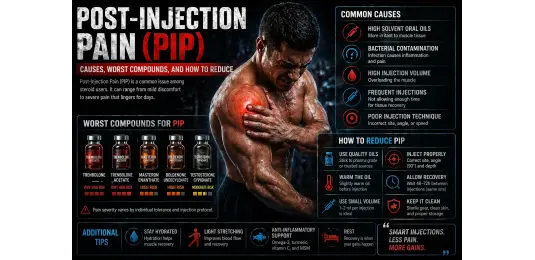
  • Highest PIP potential — short-chain esters: Testosterone Propionate (as in Testabol Propionate) is among the most consistently high-PIP testosterone preparations. The Propionate ester's rapid crystallisation behaviour on contact with body fluid in the muscle produces significant localised inflammatory response in most users, particularly at higher mg/ml concentrations. Trenbolone Acetate (as in Trenabol 100) is widely reported as the highest-PIP injectable compound in general use — the combination of Trenbolone's intrinsic tissue irritation profile and the short Acetate ester produces severe PIP in a majority of users. The broader Trenbolone side effect profile is covered at Trenbolone Side Effects.
  • Moderate PIP potential — medium-chain esters: Testosterone Enanthate and Testosterone Cypionate (as in Testabol Depot) are the standard reference point for manageable PIP. Most athletes experience no more than mild 24–48 hour tenderness at the injection site with properly dosed Enanthate or Cypionate preparations at standard concentrations (250 mg/ml). These remain the benchmark for PIP tolerance comparison.
  • Lower PIP potential — long-chain esters and undecanoate: Nandrolone Decanoate (Decabol 250) and Boldenone Undecylenate (Boldabol 200) consistently produce low PIP profiles across users. Their long ester chains remain in solution in muscle tissue more reliably, reducing crystal formation, and their broader oil bases distribute more evenly. These are typically the first compounds recommended for athletes who are particularly sensitive to injection site pain.

Concentration and Formulation: Why Higher mg/ml Hurts More

Compound concentration (mg/ml) is directly related to PIP severity — higher concentrations push the compound closer to its solubility limit in the carrier oil, increasing the likelihood of crystallisation on contact with muscle tissue. A 300 mg/ml Testosterone Propionate preparation will produce significantly more PIP than a 100 mg/ml preparation of the same compound in the same carrier oil, at the same injected volume.

The carrier oil itself also matters. Grapeseed oil, sesame oil, and miglyol (MCT oil) have different viscosities and absorption profiles in muscle tissue — miglyol and grapeseed oil are generally associated with lower PIP than sesame oil across equivalent preparations, due to faster tissue absorption leaving less crystallisation residue. British Dragon preparations use pharmaceutical-grade carrier oils that are calibrated for both stability and injection comfort at their specified concentrations.

Diluting a high-PIP compound with additional Bacteriostatic Water — useful for reconstituting lyophilised peptide preparations — is not appropriate for oil-based injectable steroids; water and oil do not mix, and injecting an oil/water emulsion causes far more severe PIP than the undiluted oil preparation. Diluting oil-based compounds requires pharmaceutical-grade carrier oil of the same type, which is not a standard practice available to most athletes. The practical solution is compound selection and technique, not dilution.

Injection Technique: The Controllable Variable

Regardless of compound and formulation, injection technique is the most actionable variable in PIP management. The following practices consistently reduce PIP severity:

  • Warm the vial before drawing: Warming the vial to body temperature (37–38°C) — using warm water for 3–5 minutes, not microwave — reduces oil viscosity significantly, allowing slower more controlled injection and reducing crystallisation tendency on contact with muscle tissue. This single practice is the most consistently effective PIP reduction technique reported across experienced athletes.
  • Inject slowly: Minimum 30 seconds per ml, ideally 60 seconds for compounds with known high PIP potential. The slower the injection, the more time the muscle tissue has to accommodate the volume without pressure-driven inflammation. Using a Syringe 1 ml with Needle for smaller doses allows better control over injection rate.
  • Correct needle gauge: Counter-intuitively, thinner needles (25–27 gauge) for injection — rather than the 21–23 gauge commonly used — slow the injection rate naturally, as the narrower bore requires more time to deliver the same volume. This slower forced rate reduces PIP for most athletes. Use a thicker needle (21 gauge) only for drawing from the vial, then switch to a fresh 25–27g needle for injection.
  • Inject into a warm, relaxed muscle: Cold, tense muscle is far more prone to PIP than warm, relaxed tissue. Inject post-workout or after a hot shower when the target muscle is warm and perfused, or physically relax the muscle by transferring weight to the opposite leg for glute injections.
  • Post-injection massage and heat: Gentle massage at the injection site for 30–60 seconds immediately after withdrawing the needle disperses the oil depot across a wider tissue area, reducing the concentration at any single point. Applying a heat pack to the site for 10–15 minutes post-injection further accelerates oil dispersion and local vasodilation, reducing the inflammatory trigger.
  • Site rotation: Injecting the same site repeatedly before it has fully recovered produces cumulative PIP that compounds with each injection. Strict site rotation — cycling between glutes, quads, delts, and for experienced athletes lats and pecs — allows each site adequate recovery between injections. A BD Disposable Syringe 1 ml with a fresh needle for each injection is non-negotiable; reusing needles produces burring and hook formation on the tip that dramatically increases tissue trauma.

PIP vs. Infection and Sterile Abscess: Critical Distinctions

The most important clinical skill in PIP management is distinguishing normal PIP from a developing infection or sterile abscess — two situations that require different responses, one of which is a medical emergency:

  • Normal PIP: Pain, tenderness, and mild local swelling beginning 12–48 hours post-injection. The area may be warm to touch. Pain improves progressively after day 2–3 and resolves completely within 5–7 days. No fever, no expanding redness, no hardening lump that grows over time.
  • Sterile abscess: A localised inflammatory pocket of sterile fluid that forms when the immune response to crystallised compound or oil is particularly intense. Presents as a firm, warm, progressively enlarging lump at the injection site. Not infected but painful and slow to resolve. Can require aspiration in severe cases. Prevention: correct injection technique and compound selection. Management: warm compresses, NSAIDs for pain, time.
  • Bacterial infection: Rapidly expanding redness and warmth beyond the original injection site, fever (above 38°C), systemic symptoms (chills, malaise), and a lump that increases in size and fluctuance over 24–48 hours rather than stabilising and improving. This is a medical emergency requiring immediate medical assessment — untreated injection site infections can progress to cellulitis, sepsis, and systemic bacterial infection. Any athlete experiencing these symptoms should seek medical care immediately without waiting to "see if it improves."

Injection site skin reactions — folliculitis or surface pustules from repeated injections in the same area — are a separate phenomenon covered in part at Acne on Steroids and are distinct from both PIP and injection site infection. These are superficial skin-level reactions, not deep muscle tissue inflammation.

Conclusion

Post-injection pain is the most practically manageable adverse effect in the injectable steroid catalog. Compound selection — favouring longer-ester preparations like Testabol Depot and Decabol 250 over short-ester high-PIP options where cycle goals allow — removes the largest PIP driver. Warming the vial, injecting slowly with a fine needle into a warm and relaxed muscle, using a fresh BD Disposable Syringe 1 ml every injection, and applying post-injection massage and heat addresses the technique variables. And knowing the difference between expected PIP and a developing infection ensures that a genuinely serious situation is recognised and addressed promptly.

FAQ

Q1. How long does PIP typically last after an injection? Standard PIP from a moderate-PIP compound follows a predictable timeline: onset at 12–48 hours post-injection, peak severity at around 48–72 hours, and progressive resolution over the following 2–4 days. Total duration for typical PIP is 4–7 days. High-PIP compounds like Trenbolone Acetate (Trenabol 100) or concentrated Testosterone Propionate can produce PIP lasting up to 10 days in the first few injections of a cycle, typically diminishing in severity as injection technique is refined and the target sites become accustomed to the preparation. PIP that is still intensifying or expanding beyond day 4 — rather than plateauing and improving — warrants closer observation for signs of developing infection or sterile abscess.
Q2. Does Testosterone Propionate always cause significant PIP? Testosterone Propionate (Testabol Propionate) produces significant PIP in the majority of users, particularly in the first weeks of a cycle — but severity varies considerably by individual, injection site, and technique. Athletes who warm the vial thoroughly, use 25–27 gauge needles, inject at 60 seconds/ml or slower, and apply post-injection massage and heat consistently report substantially less PIP than those who skip these steps. Some athletes find Testosterone Propionate entirely manageable; others find it consistently painful regardless of technique, particularly at higher concentrations. For athletes who find short-ester Propionate PIP genuinely cycle-impairing, switching to Testosterone Enanthate or Cypionate provides equivalent performance protocols with dramatically less injection site pain.
Q3. Can I train the injected muscle through PIP? For mild-to-moderate PIP, training the affected muscle is generally safe — the inflammatory response is localised and does not compromise the muscle's functional capacity beyond the pain itself. Some athletes find that light training of the affected site on day 2–3 of PIP (when the inflammatory response is beginning to resolve) actually accelerates resolution through increased local blood flow. For severe PIP — significant swelling, limited range of motion, pain severe enough to alter movement mechanics — training through it risks compensatory injury patterns and worsening inflammation. Severe PIP is best managed with rest at that site, heat application, and NSAIDs if needed, while training unaffected muscle groups.
Q4. How do I know if my injection site has become infected? The critical distinction between severe PIP and developing infection is the trajectory and symptom cluster. Normal PIP and sterile abscess: localised pain and swelling, warm to touch, maximal severity at 48–72 hours, then progressive improvement. Bacterial infection: expanding redness and warmth beyond the injection site spreading outward, fever above 38°C, chills, malaise, and a lump that continues growing in size and fluctuance (becoming more fluid-filled rather than resolving). Infection worsens over the first 48–72 hours rather than stabilising. Any expanding redness, fever, or worsening lump beyond 72 hours post-injection requires medical evaluation immediately — bacterial injection site infections are serious and progress rapidly if untreated. Never attempt to drain a suspected injection site abscess without medical supervision.
Q5. Does warming the oil before injecting actually reduce PIP significantly? Yes — warming the vial to body temperature (37–38°C) before drawing is consistently reported as the single most effective PIP reduction technique across experienced athletes, and there is a clear pharmacological rationale. Warm oil has lower viscosity, flows more easily through the needle at slower rates, and most importantly, is less likely to crystallise on contact with muscle tissue than room-temperature or cold oil. The temperature differential between cold oil and the 37°C body environment at the injection site is a key trigger for crystallisation — warm oil eliminates this differential. The method: submerge the capped vial in warm (not hot) water for 3–5 minutes before drawing. Do not use microwave heating, which heats unevenly and can degrade the compound and the vial's rubber stopper.