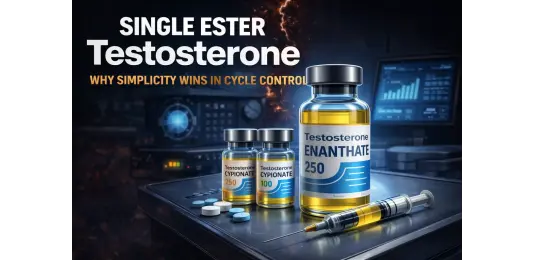
Single Ester Testosterone: Why Simplicity Wins in Cycle Control
Introduction
After reading about testosterone blends, many users start to assume that more complexity means better results. In practice, cycle stability depends much more on predictability and control.
Single ester testosterone remains one of the most reliable tools in cycle design because it gives a clear and consistent release pattern. That makes it easier to track how the body responds over time without adding extra variables that make adjustments harder.
Blends may look smoother on paper because several esters overlap. In real use, that overlap also creates more variability. Single esters work on a repeatable rhythm, which fits better with structured injection schedules and makes performance, recovery, and response easier to manage.
What Single Ester Testosterone Means
A single ester testosterone uses one ester to control how the hormone is released into the bloodstream.
This creates a more uniform and predictable absorption profile. With no competing release speeds, hormone levels follow a clearer pattern across days and weeks.
That simplicity is why many compounds from the Testosterone Base category rely on single esters. The goal is not to create a more complex hormonal environment. The goal is to build one that can be measured, adjusted, and maintained with less uncertainty.
Why Simplicity Improves Control
Predictable Hormone Levels
With a single ester, hormone levels rise and fall in a stable and repeatable pattern. That makes it easier to evaluate progress and spot deviations.
This predictability helps users plan training intensity, recovery strategy, and nutrition with more confidence because the hormonal environment stays more consistent.
Cleaner Adjustments
When a dosage change is needed, single esters respond in a more direct way. There are no overlapping release phases hiding the effect.
This makes it easier to adjust without overshooting or guessing which part of the blend is driving the response.
Easier Problem Isolation
If performance drops, recovery slows, or side effects appear, troubleshooting becomes simpler with a single ester.
There are fewer moving parts. That makes it easier to decide whether the problem comes from dosage, timing, or outside factors rather than trying to interpret several release curves at once.
Common Single Ester Options
Single esters are widely used because they balance flexibility with control. Common options include:
- Enanthate 250 — long ester with stable release and minimal fluctuations
- Cypionat 250 — smooth profile with slightly different timing
- Propionat 100 — shorter ester that allows faster adjustments and tighter control
Users often refine their approach through guides like Testosterone Propionate vs Enanthate, where ester timing, control, and responsiveness are compared directly.
Single Ester vs Blend in Practice
The main difference between a single ester and a blend is not raw performance potential. It is clarity of response.
Single esters create a direct link between dose and effect. That makes it easier to understand how changes affect the cycle.
Blends introduce overlapping release patterns. This can make it harder to tell what is actually happening at any given point.
That is why comparisons like Sustanon vs Test Enanthate often focus on control and manageability rather than strength alone. In practice, accurate adjustments usually matter more than theoretical release advantages.
Estrogen and Stability
Because single esters follow a predictable release curve, estrogen levels also tend to stay more stable when injections are consistent.
This reduces sudden fluctuations that can affect water retention, mood, and overall cycle feel.
Management is still required, but adjustments are easier because hormone changes are easier to anticipate. Resources like Estrogen Control on Cycle are often used to fine-tune balance rather than correct instability caused by uneven release patterns.
Health Support Considerations
With single esters, support strategies line up more naturally with hormone levels because the release pattern is easier to predict.
That allows users to apply support proactively instead of reacting to unexpected shifts in the cycle.
The main focus becomes maintaining stable conditions across the full cycle. When hormone levels stay more consistent, it is easier to manage cardiovascular load, lipid profile, and recovery with fewer corrections.
- Arimidex — used to help maintain controlled estrogen levels in predictable cycles
- Nebicard 5 mg — supports cardiovascular stability under consistent load
- Atorlip 10 mg — helps maintain lipid balance during longer cycles
When hormone levels are stable, support becomes more efficient. Fewer corrections are needed, and the cycle is easier to keep consistent over time.
Real-World Take
In real-world use, single ester testosterone is often preferred because it removes unnecessary complexity.
Instead of managing overlapping release curves, users can focus on execution: stable dosing, better training, and more consistent recovery.
This does not just simplify cycle management. It also improves repeatability, which is one of the most important factors in making long-term progress across multiple cycles.
Conclusion
Single ester testosterone remains one of the most practical tools in cycle design because it prioritizes stability, predictability, and control.
It allows more precise adjustments, more consistent performance, and easier side-effect management.
In structured cycles, simplicity is not a limitation. It is a strategic advantage that supports better long-term progress and more sustainable results.
FAQ
What is single ester testosterone?
It is testosterone attached to one ester, which provides a more consistent and predictable release pattern.
Why is it easier to control?
Because hormone levels follow a clearer pattern, making adjustments easier to track and apply.
Is it better than blends?
Not always, but it is usually easier to manage and more predictable in practice.
Which ester is most stable?
Long esters like enanthate and cypionate are commonly used when stable cycles are the goal.
Does it reduce side effects?
It does not remove them, but stable hormone levels can make them easier to manage.